John Corzine? John Paulson? Both very wrong in their market calls.
You’ve heard me over past 3 years talk about humility and diversification. My 21 years in the business has taught me that the investment, sector, stock, etc. that I absolutely love is still the one I need to calmly and rationally buy in an amount that I’m willing to be really wrong in and cut my losses quickly if necessary.
Worst recession since the Great Depression? Not really, although it’s not pleasant.
Unemployment is down. Good news? Yes, but not the whole picture.
Corporations profitable? You bet. They have lots of cash on their balance sheets, ready to expand and redeploy at the appropriate time.
These are just a few of the things I talk about in this week’s video. I include some nice graphs too, so be sure to click on the video to hear more!!!
TRANSCRIPT:
Hi there, Mike Brady with Generosity Wealth Management, here in Boulder, Colorado. And today I’m thinking a little bit about corporate profitability. I’m thinking of some statistics as it relates to the recession and some unemployment ex cetera. So let me just get started here.
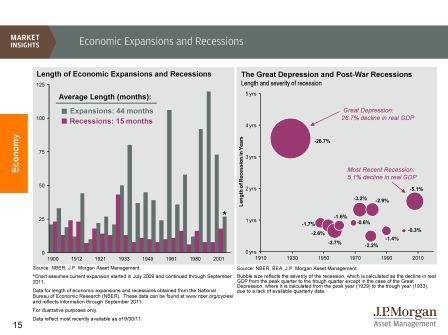
Warren Buffet is famous for saying, “be fearful when others are greedy and greedy when others are fearful.” And consumer sentiment has been down for quite some time but Warren Buffet, he has been very bullish, he’s been very optimistic on things going forward. And I just want to put things in perspective. Right now the unemployment rate is about 8.6 per cent but I think we probably all know someone who is either unemployed, been unemployed for a long time or is underemployed. And that means someone who would really like a full time job but really is only working either part time or they would like a full time job but they are at the age where they just decide to retire a little bit early. So they leave the labor force. And so the way those numbers work is if you are part-time or you’re discouraged and leave, go back to school, get more education or you retire, you come out of the available work force. And so, I think unemployment is something that really is a problem. It’s probably going to be a problem going forward but I want to provide some context as it relates to recessions and expansions. You’ve probably heard that this is the worst recession, the great recession, the worst since the great depression, and that is true. As a percentage, but I want to put some context on it just as a magnitude.
Hopefully, there’s a chart that’s up on your video there, if it’s not there, that means that my compliance department wouldn’t let me put up any of my charts here, so I’m doing two versions of this video- one with chart overlays and one without. But that being said, if it’s not there, let me talk to you about it.
The Great Depression had a twenty-six, almost twenty seven per cent decline in real GDP. GDP is the gross domestic product, kind of the national income. And most recently, we’ve had a five per cent decline, not twenty-six or twenty-seven, but five. And as a matter of fact, if you add up all the recessions we’ve had since the great depression, they’re about what we had in the Great Depression itself. So just to provide some context, it’s actually relatively small even though the negative five per cent is the biggest one since that huge number in the ‘30s. But the average length of an expansion is forty-four months, and the average length of a recession is fifteen months. And technically we are not in a recession right now. Although it doesn’t feel that way- I know that!
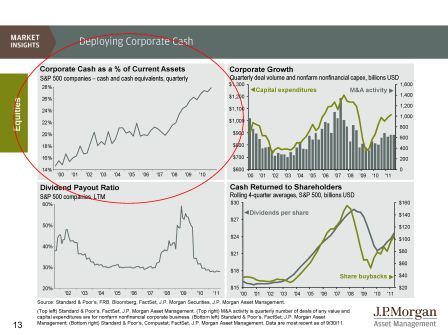
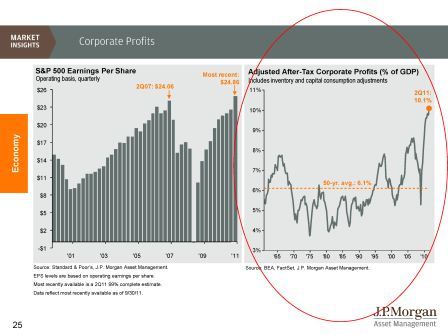
Corporate cash: corporations are holding on to a lot of cash at this point. They had, as all of their kind of short term assets, their current assets, back in 2000, about fourteen per cent of their current assets were held in cash. Today that’s about twenty-eight per cent. As a matter of fact, just since ’08, it’s gone from twenty to twenty-eight per cent. (See chart inlay.) Apple’s got over 70 billion dollars in cash. And so the corporations themselves are getting stronger, it’s that simple. Their after tax, corporate profits are over ten per cent at this point. And so that was negative just a couple of years ago and right before the huge crisis of 2008, 2009, it was not even nine per cent. So this is really at a high for corporate profits, after tax corporate profits. And so we just have to keep that into consideration.
They’ve got this cash, kind of on the sidelines, waiting to redeploy it into research and development and to purchase other companies and expand their businesses when the opportunities are ripe. When they also know that the demand is going to be there for their products. So it’s a kind of a wait-and-see, they don’t want to do it too quick because then people can’t buy their products or services. But they can’t be too late because they want to be there, sort of “just-in-time” when the right ingredients are there.
That’s what I’m thinking about this week. There’s just a few more things I want to talk about that are actually a little off-topic.
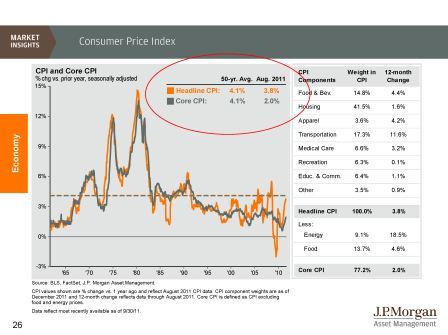
The Consumer Price Index, the CPI, is …, a lot of people talk about it being three per cent, 3.2 per cent, for the last fifty years, it’s actually averaged 4.1 per cent. I mean, it’s been hugely high, you know, fifteen, sixteen, seventeen per cent. Right now it’s very low at about two percent on the core. But the average is about 4.1 per cent, which is higher that a lot of people talk about when they are doing their retirement plans.
The end of the year is coming up as well, so the last thing I want to leave you with is: you can do IRA distributions to a charity this year, all the way up to 100,000 dollars. And it’s hopeful that the law will be renewed for next year, 2012, but it’s not guaranteed. So if you have an itching, you know, to do some IRA contributions directly from the IRA right into a charity without it counting as taxable income then give me a call and I can talk to you about that. I really would love to help you out in that regard.
Sorry it’s a little disjointed today but I just had some stuff I really wanted to talk about so I really, really hope you enjoyed the video.
Mike Brady, Generosity Wealth Management; I believe that money can and should do good things for you, your family and the causes you believe in. My phone number is 303.747.6455. I am comprehensive, a full service wealth management service for my clients and I’d love to talk to you if; I love my clients, if you’re looking for something like that or if you’re my client it’s getting to the end of the year, beginning of next year, I know we’re going to be talking, kind of structured as we do our annual review, here very soon. We talk throughout the year but this is a time where we really get together so I know we’ll have lots of conversations going forward. Mike Brady, Generosity Wealth Management and I will talk to you next week. Thank you. Bye bye.
It’s my belief the volatility we’ve seen in the past few weeks, months, and year will continue going forward. I also believe that more active management may make sense to take advantage of this market condition.
I talk about this in my video.
I also discuss the rising healthcare costs in your future and that I have software that will estimate what lump sum you may need upon retirement to fund your healthcare under certain assumptions.
Fun stuff! Click on video to hear more!
TRANSCRIPT:
Hi there, Mike Brady with Generosity Wealth Management, here in Boulder, Colorado. And I am really pleased to be talking with you today and there are a couple of things I want to talk about today.
And the first one is volatility. On Wednesday, we had a DOW that was over 400 points up, and this is following the Thanksgiving week where the market was sharply down. (Low volume but still sharply down.) And it’s my belief that this type of volatility, and not just in the last couple of weeks, we’ve seen a lot of volatility in the last year or so, I believe it is going to continue going forward. And if that is true, it’s also my belief that some active management should be considered for client’s portfolio. That’s something that I’m going to be talking with my clients about in the coming months. That’s also something I’m going to be talking about in these videos in the coming months, that it may have a place in a volatile environment- how can we best position our portfolio to take advantage of that particular market condition? So, if you’re not one of my clients, I recommend you give me a call so that we can talk about it, kind of one on one, and your personal situation.
And the second thing I’m thinking about this week is well, healthcare costs; and specifically as it relates to retirement.
I heard a statistic yesterday that is very interesting. The Fortune 100, 91 out of the Fortune 100, in 1985, had traditional pension plans. Today, the Fortune 100, only 19 of them have traditional pension plans. If you’re a GE employee, starting today, you know, day one of your employment, you are not offered their traditional pension plan. And that is, GE is one of the largest companies, with the largest pension plans. So, I think this is a trend that is going to continue going forward. And what this tells us is that you’ve got to take control of your saving and investing for your own retirement. Don’t assume that someone else, either some big corporation or even Social Security is going to handle it. You’ve got to take control of it!
And one of the largest expenses you’re going to have in retirement are your health care costs. And fifty-three per cent of individuals recently polled couldn’t even estimate what those health care costs are. We’re talking Medicare A, and B, and D, and your estimated premium payments, and your estimated out of pocket expenses. These are some expenses that you’re going to have to, you know, pay in your retirement. So the question is, in your life expectancy, what are they going to be, what kind of a lump sum, under certain assumptions, will you need to have in retirement? And of course the question is- do you have that set aside? You may, you may not, but let’s try to quantify that on a piece of paper.
I have some wonderful software that I’m going to be working with clients with in the next couple of months to try to put that number down on a piece of paper so that we can say, “Boom! This amount of money is what, under these assumptions, we’re going to need for the healthcare costs for the rest of your life.” So the question is, have you done that for yourself? Maybe you have. If you haven’t, give me a call I can try to help you answer that question. It’s a hard number to really put down, things are always in motion, but you know what, let’s try to estimate as best we can. An estimate is better than not having any idea at all. And it is something we can revise as the years go forward.
So anyway, that’s kind of what’s on my mind this week. Mike Brady, Generosity Wealth Management, 303.747.6455, here in Boulder, Colorado. A comprehensive, a full service wealth management firm; I love my clients, I have a great passion to treat my clients like members of my family, and if you’re not my client, I’d love to talk to you about whether it makes sense if what I do is right for you, or if I’m the right person to help you with that. So, anyway, you have a wonderful week and we’ll talk to you later bye bye now.
The 3rd Quarter 2011 is over and I have a slightly longer video this week because I want to address the current environment and how things may shape up going forward.
A big theme is my advice to assess your overall plan and risk tolerance, and also to ensure you’re looking at both positive and negative points of view on the markets instead of just one view over the other.
I send my newsletter and videos on a weekly basis, so if you watch only a few througout the year, at least watch my more comprehensive quarterly videos.