“Life is really simple, but we insist on making it complicated” – Confucius
The first half of the year is over, and the year has been up and down on an almost weekly basis.
There are reasons to be positive, and pessimistic.
In this month’s video, I outline why you should be optimistic, and reasons why you can be concerned. In most areas of life there are pros and cons, but the question is which one wins out on balance.
In this case, and I outline this in my video, the positives outweigh the negatives.
But that being said, the fundamentals of reaching your goals remain the same–diversify, have a long term vision, and keep your emotions in check.
Hi there. Mike Brady with Generosity Wealth Management; a comprehensive full-service financial services firm at headquartered right here in Boulder Colorado, although I’m recording this video from our cabin in Wyoming. Hopefully you had a wonderful 4th of July, maybe you took the whole week off. I came up here for the whole week it’s kind of an annual tradition and it allows need to get some business projects done, but even more importantly to get away from the hustle and bustle of the daily life, get my emotions in check, which is of course one of my big recommendations for my clients and for investor.
I’m going to cut right to the chase of today’s video because it’s going to be a mid year report, but the fundamentals of investing and being successful in my opinion have stayed the same, which is to stay diversified, be long-term and keep your emotions in check. That’s one of the fundamentals and I just think that that’s absolutely important.
Today I do want to talk about what’s happened so far and talk about the reasons for being optimistic or pessimistic for the rest of this year. Nobody knows the future. I certainly don’t so this is my analysis so this is one of the reasons why those three that I brought to you, be diversified, long-term, keep your emotions in check are so very important because when someone says they know absolutely what’s going to happen, the impact of this policy or that policy they know exactly what’s going to happen they’re lying to themselves, they’re lying to you and so I don’t think that anyone is well served by that particular approach. So here so far this year the market was up pretty dramatically in January, continuation of low volatility and good market in 2017 coming into 2018; February and March very difficult. And then the second quarter recovered as some of that, but really was really more in general in the unmanaged stock market indexes and bond indexes basically a flat year so far. Plus or minus a couple percent in my mind is flat.
I’m going to throw a chart up on the screen where you’re going to see is we’re in a consolidation period. The markets go up, down and sideways and so far this year it’s a sideways. It’s always irritating to have; everybody wants the up with no volatility and that’s just not the world that we live in. What we’re seeing right now is a time where patients makes a lot of sense. Those are the people who are rewarded long-term and so remember that as you look at your particular investments and your particular approach.
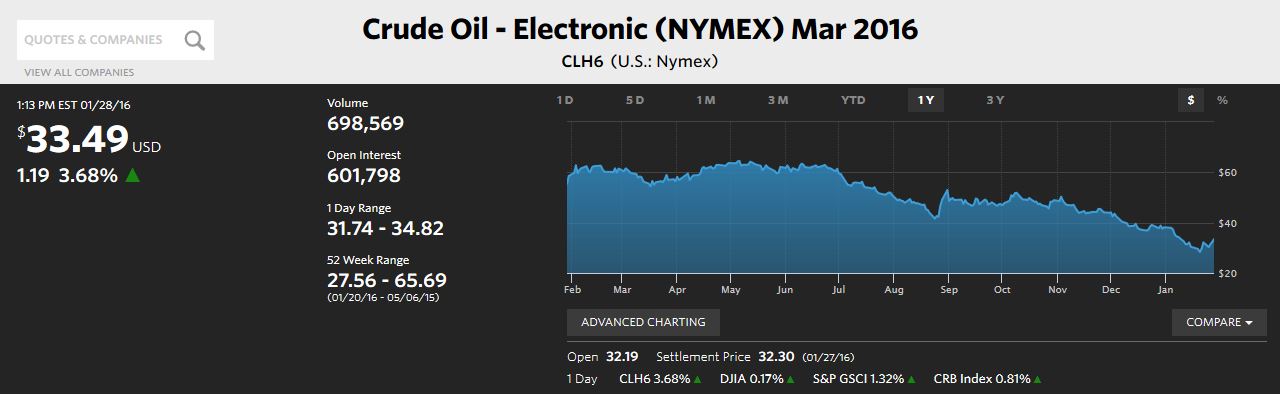
Now, I’m going to put a number of charts up on the screen and I’m going to talk about some of the reasons to be optimistic, some of the reasons that things could look very good. So let’s go through them. The first one is strong U.S. economy and that’s shown a really above average pace with tax cuts, higher government spending, ultra low unemployment rate, the biggest increase in business investments in years, we’ve had an earnings per share that’s very high and the Fed is normalizing monetary policy, and the last is equity valuations are not as pricey as they were just a couple of years ago. And so this is a good reason to be optimistic and in my opinion, I’m not going to lie to you, the pros outweigh the cons. Here are some of the cons: The price of the oil is back up high in the last year or two; it’s around $75 for a barrel. However, I will also put it into context that it is where it was three years ago and lower where it was four years ago and I don’t remember the stock market being horrible during that time frame. Always up and down that’s just part of the deal, but it is not a travesty. Excessive fiscal stimulus in a full economy could lead to an overheat. Got it. And then the third is the tariffs, which I want to talk about here today.
Tariffs over the last number of administrations they have talked about how the barrier to entry, some of the costs of doing business with other countries is greater than it is here. It’s easier for people to import it into the United States than it is for us to export to other countries. That’s what the tariff discussion is all about. So the discussion is out there, has been out there for a long time, the question is what do you do with it? So one of the reasons why, and I’ll jump to the conclusion on this too, while it’s an irritation it’s a wrench into all of the pros that I just brought up it’s not necessarily a deal killer and the U.S. could actually win on it. Some people say they know absolutely this is horrible for the U.S. or they say it’s absolutely horrible for other countries. The bet that President Trump is making is that others will blink before the U.S. will or before he will. And so one of the reasons why that might be the case is the reliance that other countries that we have had these discussions with and imposed some tariffs on are much more vulnerable than we are. Their stock markets are not doing as well as ours are and their economies are not doing as well as ours. We are the strongest out of all those that we have imposed these tariffs on. Our exports are 12 percent of our economy, whereas in China it’s 20 percent, in Canada it’s 1/3 and in Germany it’s 50 percent. They’re much more reliant on exports to us and to other countries as we are exporting to others. So we only do 12 percent of our economy is based on exports from the United States because we have such a big country, we have such a vibrant interstate commerce from city to city state to state that we are less vulnerable than many other countries.
And so that’s why when I weigh something negative like the tariff discussion and wars against all of the positive it’s the net still going towards the positives than it is on the negative. If you’re only focused on the negative, sorry you’re going to be very disappointed and of course you’re quite dark about that. I on the other hand want to balance both of them and that’s why I’ve come out net on the positive. So I’m optimistic for the rest of this year. I’m not making any changes wholesale in client portfolios, in my discussions with clients, et cetera. Sticking with those particular fundamentals it’s served us well the first half of the year, I think it’s going to serve us well the second half as well. Be diversified long-term, be cool, cool as a cucumber.
Mike Brady; Generosity Wealth Management; 303-747-6455. Give me a call at anytime. Thanks. Bye bye.
“Our greatest glory is not in never failing, but in rising every time we fall”
– Confucius
The last few days have seen lots of headlines and news about the markets, and you may be wondering what this all means.
History has shown that investors are rewarded for steady nerves and long term vision. If you’;re in your 60s and 70s, hopefully you still have many years in front of you, so your vision should be long term.
Volatility is normal, and the low volatility we’ve seen in the past few years is the exception, not the norm!
Click on the special video for my up to date thoughts.
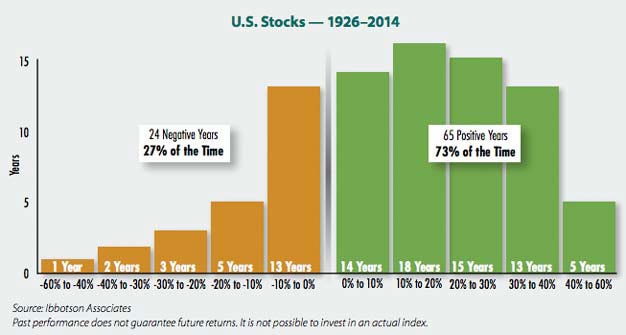
With an unmanaged stock market index going back to 1926, 73% of the time U.S. Stocks were positive. When you add in the “slightly negative” column of declines from 0 to 10%, that adds up to about 87% positive or slightly negative.
The future could absolutely be different, and you have to ensure it fits with your individual goals.
The last month has been interesting to say the least. This is a wonderful time to ask yourself
Are you an Investor or a Trader?
The mindsets are completely different, leading to different behaviors, and different outcomes.
I ask this question in my video this month, talk about the differences, and let you decide by the end which of the two you are.
So, what do you think? Are you an Investor or a Trader?
Click on the video
Transcript:
Hi there. Mike Brady with Generosity Wealth Management, a comprehensive, full service financial firm here in Boulder, Colorado. Today I’m going to ask the question and by the end of the video hopefully you’ll answer it for yourself. Do you have the mindset of an investor or as a trader? Because they are two different mindsets. An investor is long term, a trader is short term.
Let me talk about a few things in order to help you answer that question. When I talk with people – when the market goes down and I talk with people and perhaps I hear some trepidation, some concern, some worry, I think unconsciously they’re worried about losing everything. Their hard earned savings all gone. They go from having money to nothing. Unconsciously even if they don’t even know it themselves that’s what’s going through their heads.
Let’s talk about some situations on TV or in the newspaper that you’ve heard about where that has happened because that does happen periodically. First off it’s usually a sweet lady or a sweet couple, okay. And they’ve invested everything into maybe a single stock. They’re completely undiversified. And many times that might be something that is exotic. They invested everything in some gold that maybe their brother-in-law or their son-in-law convinced them to buy. Or maybe it went all into one sector like technology or Internet. Or maybe they bought something like coins and then they lost it all and they found out that it was a scam. Many times included in this story is non-liquid. Maybe they bought into a shopping mall and that shopping mall, you know, come to find out is filled with asbestos or something bad and they lost everything. Or it was some kind of a private investment that went belly up. And so I think that these are some of the most common themes when you see people lose it all on TV or when you hear about that.
So therefore let’s talk about that. What are the lessons from it? One, hey if you’re a sweet lady and couple you can stay that. That’s cool okay. But all the others we can avoid, okay. Let’s not go into individual stocks. I am a firm believer in diversification and while we’re in a general decline market diversification does not guarantee against losses, okay. That’s one of the disclaimers we have and it’s true. I’m going to talk about why diversification does make sense.
You shouldn’t go into things that are exotic, okay, in my opinion. Gold and tech and coins and things of that nature. Instead invest in those things that are the market. I talk about the general stock market and the general bond market whatever that mix might be for you specifically in your situation. And I believe that liquidity is very important. And understanding that when you are illiquid if it turns against you you can’t get out of it. And so knowing what your liquidity is and how quickly you can convert to cash if you feel that you’ve erred in our choice of those things.
So one of the other things that I think people do is they feel that the market is linear, okay. And when I mean linear that’s, of course, means a straight line. And it just doesn’t work that way. When a market has gone down five percent it does not mean it’s going to continue to go down another five percent. You can’t annualize. You can’t take a short time and make it a big time. And, of course, the reverse is the same thing. You can’t take well the market went up five percent so therefore it’s going to end in a year at 10 percent of 15. You just can’t do that. Just because it went up doesn’t mean it will continue. Just because it went down doesn’t mean it will continue. As a matter of fact, the market has a tendency and I’m going to show a graph later on to go up and go down. And so therefore if you believe that Point A is here and Point B is here, okay, further out then it’s going to be wavy along the way. And so the higher it goes the sooner it is to a downturn. And the sooner it is when it’s going down the sooner it is to an upswing. So that mentality I think is very, very important.
But let’s pretend like what we’re seeing right now is 2008 again. Let’s pretend like that’s the situation, okay. I’m going to put up on the screen there a graph and I’m going to try to highlight it, make it really big. But if you had invested in the S&P the highest point. You had three different portfolios there, a 60 percent stock and bond or a 40 percent bond and stock or a 100 percent stock market index the S&P 500. You invested spectacularly in October of 2007 at the worst time. And you went through the decline of 2008 which was the worst decline in the S&P 500 going back except for the early 1930s, okay. So it was the absolute worst and definitely in our lifetime, for most of our lifetimes.
And so two year breakeven on a 40-60 split. You know you had absolutely horrible timing or you invested and then you gave some of that up, some of those gains. Two years later you broke even, okay. Okay. I mean if your time horizon is two years you shouldn’t have any investments in my opinion except for cash or extremely short term instruments of some type – CDs, whatever it might be. But even if you’re retiring today or you just retired hopefully your time horizon is many decades. I’m hoping you’re not dying in two years or three years or four years. None of us know of course the future but hopefully we are going to have many many years, okay. And so that is very important.
If you had a 60 percent S&P 500 and a 40 percent bond index your breakeven was three years. I mean that’s on the worst in our time, okay. I’m going to put up on a chart there the time, diversification and volatility of returns. You’ve seen this before if you’ve paid attention to my videos which I certainly hope you have. And so at the first band of bars is one year, second is five years, third is 10 years and then 20, okay. And so the first bar is 100 percent stock market index. The second one is 100 percent bond index and that kind of ugly brown is a split of 50-50 stock and bonds.
So what you’re going to see is going back to 1950 – 1950, okay. That’s 50, 60, 64 years, 65 years, okay. We just finished a year. Sixty-five years of returns a diversified portfolio of stocks and bonds squished together like that. The worst that you’ve done – the worst – not the best, the worst is one percent on average per year. And you can see from that previous chart that sometimes there are years where you’re negative, okay. I mean you are not entitled to positive returns every year when you are invested hoping to get good positive returns over a long time horizon. That is part of the deal. If your time horizon is very short well that might be different. You’ve got to consider why the heck am I in some stocks and bonds if I need this money in a very short amount of time.
As you go out 10 years and 20 years the same, you know, has it normalizing. It continues to go – the absolute worst is making a couple percent a year on average, okay. That’s the worst. And the best is of course much better. This includes that 2008 timeframe. This includes the tech bubble. This includes 1987. This includes the 1970s which were pretty horrible. I was alive in the 70s but I was a young kid. I’m 47 so – almost 47, okay. This week. Send me a birthday card.
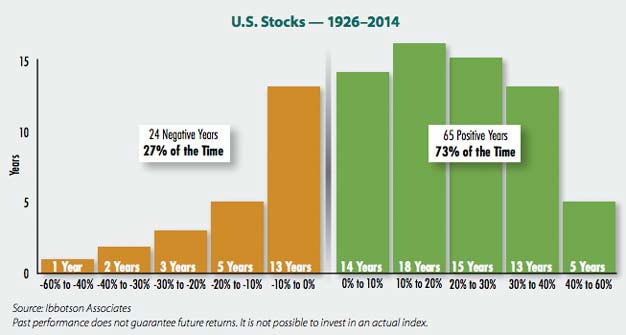
So I want to show a graph right there. You see it up on your screen. This is going back to 1926 and this includes the Great Depression. This includes the great recession, okay, of 2008. And what you’re going to see is 73 percent of the time we had positive years. Three out of four, okay. And then when we add in that one bar there of zero to 10 percent this is how the year ended by the way. Almost nine out of ten years are positive. Not 100 percent. You can see on the left hand side one and two years, you know, out of 89 years were the really bad ones that we really, really hate – negative 30 and 40 and 50 and 60. Oh, those are horrible. We hate those. But they’re very infrequent. That’s the point, okay. And even when they do happen, even when they did happen if you had a diversified portfolio then the recovery period was very short. And so these are one of the things that we as investors have to understand.
Going forward it could absolutely be different. Anyone who tells you that they know the future is lying to you and trying to sell you I don’t know – a sack of potatoes or something. And I’m not trying to do that to you. I’m trying to be as realistic as I can understanding that we live in uncharted territory. And by definition the future is uncharted territory. Which is one of the things that I want to talk about. I mean every once in a while someone will say to me yeah, but it’s different. I mean you can’t really say that the 1950s and 60s are the same thing as 2015 or 2016. Yeah, absolutely. I totally get it. And 2008 is not the same as here, okay. Every year is different and every year there is always something whether it’s the downgrade of the government by the S&P, you know. The trip way down. Whether or not it’s a war. Whether nor not it’s the concerns about a war. Whether or not it’s quantitative easing or it’s not or it’s tightening. Every year I could sit here and point out a year and I’ve been doing this for 25 years.
I like to think of it like the presidential election. You know how every four years you hear well this is the most important election of our lifetime. I don’t know. After a while it starts to lose its impact on me because if every four years is the most important of my life, darn, you know, they’re all important. I get it, okay. To say that they’re all the most important and it’s the same thing with an investment, right. You looking at it from a long term point of view and do you believe that Point B, that future, is better than it is today. If the answer is no then that’s your own choice to do then why do you have any investments whatsoever? I mean really why do you have any?
So I believe that every year is different, okay. However, history does have a tendency to repeat itself and that’s what we are working on. And I believe that I’m still very bullish on the markets and I do believe in diversification. Gold, silver, commodities. I don’t like them, never have. Essentially they are very, you know, let me just tell you a little insight. They have a tendency to go up with inflation except when they go opposite, okay. And they really go up when the stock market goes down except when they go down with the stock market too. I mean I hate the correlation. They have a tendency to have a mind of their own and I’m just not – and I don’t think that true investors are going into something that you have no control over like a commodity of gold and silver and things of that nature.
Let’s not forget that the pundits that you see on TV, that you see on any of the cable news or at the end of the day, their job is to get you excited. They’re sort of like when they cover – like a politician. A politician who’s trying to win election is there for hey look at me – bright, shiny light right on me. Their job is to be entertaining and to tell you maybe what you want to hear. Maybe get into your fears and also feed your hopes, okay.
I’m like a policy wonk, okay. I’m sometimes boring. You’re like gosh Mike, you know, why do you have to say that when it’s exciting to get maybe ignore and then overreact. And that’s just not me. I’m here to try to be as upfront and try to be as non-emotional as I can. Still being passionate – hopefully you get that as you listen to me. I have passion for what I do but I want to be non-emotional. And so getting back to my original question an investor is someone who looks at things from a long term point of view, understands that the decisions that you make, your behavior, is probably going to – your behavior and how you react to it or not emotional as you look towards to the long term. You know what? Ups and downs are a part of it. A trader on the other hand is always looking for well what about this and what about that. Always looking for maybe a short cut, maybe a get rich quick scheme. And also worried about these fluctuations that are going to happen. They will always happen and they always have, okay.
And so I want you hopefully to be an investor versus a trader. But if you want to talk about it some more you give me a call. (303) 747-6455. Generositywealth.com. Great to talk with you today. One month, one six months, one year. You know what? When your time horizon is multiple years and hopefully multiple decades it really doesn’t matter. In the whole scheme of things it doesn’t matter. Find something that allows you to stay with your plan. That’s what’s important I think. Anyway, have a great day. We’ll talk to you later. Bye bye.
The S&P 500 is now almost perfectly correlated to the price of oil, which is interesting because over the past decade they’ve had virtually no correlation.
Energy only makes up 3% of the economy.
So why the focus?
Falling prices often signal softness in demand, which precedes an economic slowdown. But, most believe this is a supply glut, not weakened demand
Cheap oil is causing US Oil production to cool off, hurting energy companies and states heavily dependent on oil
The threat of Oil Loans imploding (raises the risk in the banking sector
Russia, Venezuela, Brazil, and others that rely on oil exports could lead to an emerging debt crisis
Fresh doubt about whether the Federal Reserve will be able to raise interest debt
With an unmanaged stock market index going back to 1926, 73% of the time U.S. Stocks were positive. When you add in the “slightly negative” column of declines from 0 to 10%, that adds up to about 87% positive or slightly negative.
The future could absolutely be different, and you have to ensure it fits with your individual goals.