The tsunami that hit Japan last week and has affected their nuclear reactors is causing great concern in the stock markets.
The Nikkei dropped 11% a few nights ago. The US markets have dropped 2% this morning (Tuesday as I write this).
Now is the time to determine if you’re gambling or investing?. Is this an emotional sell off or a harbinger of things to come?
I discuss Emotional Selling in my video this week.
TRANSCRIPT:
Good Morning Clients and Friends, Mike Brady here.
This week I want to talk about emotional selling. The tsunami hit Japan late last week. I’m recording this on a Tuesday morning and overnight the Nikkea went down 11%. It is just absolutely getting killed. Our markets have opened up very sharply down. So the question I’m posing is what do you do in a situation like this? If your first inclination whenever a huge catastrophic event happens, and now we’re trying, and looking and waiting for what’s going to happen with these nuclear reactors, is if your first reaction is to sell, “I’ve got to move right to the cash!” Then you might ask yourself, are you gambling or are you investing?
What I look for, and if you watch some of my videos, particularly my beginning of the year video (hopefully, you’ve watched it time and time again, it’s must watch) that we’re looking at months, weeks, and the year, of what the market is doing; the value of it, the quality of the market. Because there always going to be events like Japan right now, is happening. I don’t want to minimize the impact of what is happening there in Japan. Japan is a huge global economic player and what is happening there is absolutely horrific. So please, don’t take this the wrong way- that I’m trying to minimize it.
But I am looking at historically, there have been huge events- in our most recent times, the last 20 years or so, there’s been Gulf War I, there’s been Gulf War II, there’s been 9/11- where the market really went down. When the markets reopened that, you know, the week after, and the quarter ended up being positive; the next quarter after that.
So, you know, the major impact that this is going to have, I don’t know yet. I absolutely acknowledge that I don’t know and anyone who says they absolutely know is pulling your leg.
What I will do is to continue to watch this very closely. I do not get emotional about it. You know, emotional selling I think, doesn’t serve anyone’s best interest. I might change my mind in days, in a week, and in a month. That is why you can’t be beholden to your theory, you know, so very stringently. But you do have to kind of keep a straight arrow. What are you doing? What are the value of the market? What’s the impact going to be, not just the immediate impact but one month, one quarter and one year from now? And, with all the data that I have right now, as it’s being compiled, etc., I’m not convinced that now is the time to sell out. So I’m not doing anything with my portfolios for clients. But you know, I will continue to keep you abreast that’s why I have weekly newsletters so you can know what I’m thinking.
Anyway, I just wanted to kind of touch base on that. Hopefully, you’re getting this video, I’m doing this on a Tuesday morning, getting it a little late to my compliance department. And hopefully they’re really good about getting it turned around so you are getting this on a Wednesday morning. If not, you’re getting it as soon as possible.
So anyway, have a wonderful week. I’ll keep you informed.
My company is Generosity Wealth Management. I am a registered rep with Cambridge Investment Research. 303.747.6455. I am here in Boulder. If you’re my client, I love you. If you’re not my client, I still like you but I’d love you to be my client. 303.747.6455. Thanks bye bye.
Japan has been in a continued recession for the past 20 years.
The deficit levels of the Japan government are among the highest of the developed countries, and expected to increase in the coming years.
This is not good news for Japan. As the rating decreases, the extra premium paid to borrow money goes up. So, a 3% cost of borrow might increase to 4%.
Anyway, this is something to watch as the United States deficit to GDP is increasing rapidly.
You’ve been reading my newsletters and saying “boy, that Mike Brady knows everything”. That may be true, but it’s good to remember the markets have a mind of their own.
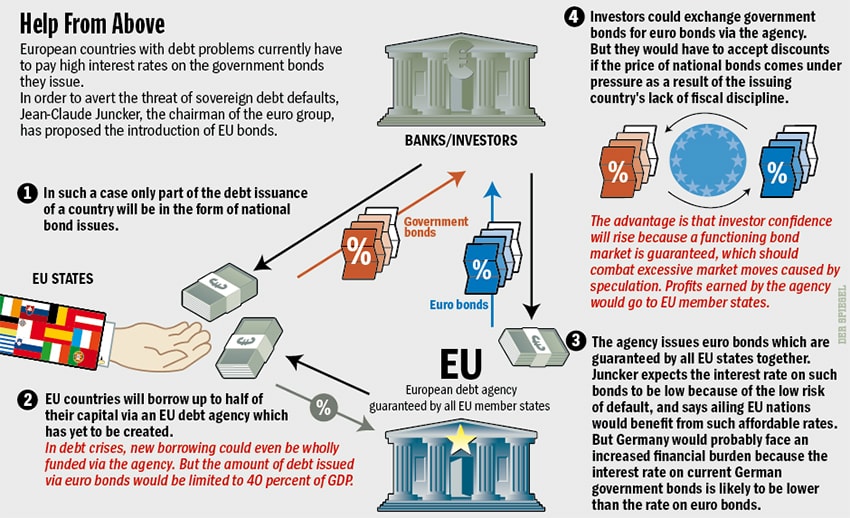
The Euro has rallied against other currencies recently.
Do I think this is a short term rally? Yes. Do I think the Euro and Europe in general still have long term problems? Yes.
There are many indicators out there for helping to inform which way the markets are headed. None of them are perfect, or exact, or even able to be taken into account alone and without context.
This week I discuss the CBOE Volatility Index (VIX) and how it’s negatively correlated with the equity markets.
The fact that it’s at extremely low levels right now makes me concerned.
Take 2.5 minutes to watch/listen to my video
TRANSCRIPT:
This week I’m thinking about volatility index. I mentioned two or three weeks ago on my annual preview, that I was concerned that the, Vix, the “V,I,X,” which is the volatility index is very low. So I’m going to throw up a couple of charts up on the screen here. So that you can kind of see that when the market has a tendency to go down, volatility dramatically goes up. It doesn’t necessarily mean that one is a leading indicator versus a lagging indicator, but they are, they are correlated. And it’s something that I kind of watch for. If you look at April of last year, April of 2010, they really start, the volatility dramatically goes up right as the market through April, May, and into June, really, really wasn’t very good.
As I throw up a 5 year chart, you can see that at various times, the same thing happened. That the volatility goes up when the market goes down. And so the fact that it is down right now does not mean, it being down, the Vix is at a very low number, it’s between 16 and 17, right now, then it does not mean the market is going to go down. As a matter of fact, with quantitative easing, I would actually argue that the market is going up because of the quantitative easing. It may continue to go up. This is just one of the things to watch for.
A client asked me the other day, you know, what are some of the indicators that I use, and I look at, etc.? And I have to tell you, it is not just one. It is many many, many different technical indicators. It is many, value of the whole market, but you know, for me, if you’ve been watching my videos, diversification. Because even if you are wrong on the indicators you’ve got to be very very well diversified in many different asset classes, etc.
Anyway, I just wanted to talk a little about the Vix, how very low it is and how it correlates with the market many many times.
My name is Mike Brady. Cambridge Investment Research, is my, I’m a registered rep of. My company is Generosity Wealth Management in Boulder, CO. My phone number- 303.747.6455. And you have a wonderful week, bye bye.