It is common for there to be declines in the markets throughout the year, sometimes even double digits declines.
This is to be expected.
As an investor, one of the reasons we diversify and modify our allocations throughout the year is to try to minimize these fluctuations.
What should you do when there is one of these expected declines? It depends on the situation at that time.
Please click on the video below for a 4 minute discussion I give on this topic……
TRANSCRIPT:
Hi there, Mike Brady with Generosity Wealth Management, here in Boulder, Colorado. And I this week I want to talk about intra-year declines, and frankly, the correlation they have with the end of the year returns. Because, I talked about this just a little bit when I did my end of the year video (kind of beginning of the year video) where I said that on balance, I’m optimistic for 2012. And at that time I said, “listen, it’s common for there to be volatility,” but volatility has increased in the last couple of years and I believe that volatility will continue going forward.
It is common for there to be, within the year (intra-year), declines that we seem to forget after the year is over. Negative, kind of from the high to the bottom, within a year of you know, eight, nine, even double digits, but that doesn’t mean the year is going to be horrible. So as 2012 unfolds, we’re going to find some times where it’s not as high as it used to be, OK? That the market has declined, and that is part of the process, part of the journey and the travel. Now that being said, the reason why we diversify, and we adjust our allocations throughout the year is to try to minimize the impact that we have. But we know that it’s going to happen.
So the question that we ask ourselves at that time is, “why is this going down, you know, why is the market going down like that?” Is it event driven, where there’s a lot of emotion around it? Is it value driven? What’s the cause of it and at that time, do we believe it will continue to go down, or do we think that this is just going to be one of those normal, you know, fluctuations, and staying invested is the right thing to do? I don’t know what we’re going to do at that time, but I’m preparing you right now for that, you know, almost inevitability. OK?
I’m going to throw up on [screen] here… here are some intra-year returns and then declines and then the annual return. And you’ll notice even in the last two or three years, a twenty-eight percent decline in ’09, sixteen in 2010, and even last year there’s a nine-teen percent decline and it ended up the year, and that’s on the S & P 500, which is an unmanaged index, that doesn’t necessarily mean that the year ended on a decline.
So, you know, one thing I want to talk about is as well, that when I say that I’m more optimistic because I look at the value of the market and I believe that the prices are…, I believe it’s an underpriced market right now, that does not mean that I discount all of the negatives out there. The way I like to think of it is, there’s a scale, there’s all these things on the negative side, and all these things on the positive side, and which way is it going to tilt? And it is still acknowledging that there are negative things. And someone else, another analyst, might take the same data and say, “no, I’m going to weigh all the negatives a little bit more than the positives.” And so there are always positives, there’re always negatives out there and the question is- how do you weigh them? And which one is a little bit more than the other? And of course, you might adjust your opinion as the year unfolds.
So anyway, that’s one thing I wanted to talk about this week. I hope that you’re doing well. The Super Bowl was a couple of days ago, and frankly I’m recording this right as we’re going into the weekend so I don’t know who won but you do, so hopefully your team won.
Mike Brady, Generosity Wealth Management; I’m a comprehensive, holistic, wealth management firm, with tax planning, estate planning, investment management, retirement planning, I really try to do all of those in order to help my clients meet their goals. Mike Brady, Generosity Wealth Management-303.747.6455.
You have a wonderful week! I’ll talk to you later, bye bye now.
Goodbye 2011 and hello 2012! What happened and what’s my outlook for 2012? Optimistic or pessimistic?
Watch my video to find out.
TRANSCRIPT:
Hi there, Mike Brady with Generosity Wealth Management, and today I want to talk to you about a little bit of a review on 2011, but spend most of my time talking about the current situation right now. And you know, maybe do a little bit of a, …, thinking about 2012 and what the future may hold.
2011 was a real volatile year. I mean frankly, when we look back at year upon year we can always say that it’s very volatile. I’m going to show you a graph in a minute or two that actually shows, we kind of forget about it, but many years have large declines intra-year. So 2011, (I’m going to throw this box up there); this is kind of a style box from value, blend, growth, and large, and mid, and small cap.* And by the way, I’ve got lots of disclosures at the end of this video so I highly encourage you to read those disclosures about the unmanaged stock indexes. So what you’ll see is, in general, the U.S. market was up a couple of percent to down five or six percent, but it was a wild ride the way we got there.
The first four, four and a half months of the year were up starting in May and June, we saw some weakness and then August and September were really quite brutal. Just huge, you know, hundred point swings in the DOW every other day and it was really quite painful and there was a huge focus on the downgrade of the U.S. government by S & P and a real focus on the U.S. federal debt. And, you know, 2011, one of the surprises was how well bonds did. I know I’m very surprised. And Bill Gross, who runs one of the largest funds out there, particularly bond focused funds, he admitted half way through the year, well maybe three quarters of the year, that he guessed it wrong. So, I think that how well the bonds did in 2011 is going to be the big surprise. But that’s why we remain diversified. Because my experience has shown, in twenty-one years, that the thing that you love the most sometimes you’re just darn wrong about! And so the thing that you hate the most, sometimes you’re wrong about that as well. So it’s really looking at the percentages, maybe weighting one over the other and changing that allocation throughout the year.
So you’re probably wondering about 2012. Right here in my hands I’ve got “15 Experts Predict 2012,” a little article. And we’re talking big names, Goldman Sachs, and UBS, and you know, kind of every big name that you can think of out there. And frankly, one article says that China is the best thing in the world, then the next one says China’s going to be a problem. One says that the U.S. is going to have great growth and the next one says it’s going to have poor growth. One saying bonds are good, one bad, and really the answer is always unclear, this year is no different.
I do believe we’re going to continue to have volatility, and one thing that I’m going to do is meet with clients and talk about whether or not some strategies need to be implemented to take advantage of that. But I am optimistic about 2012. I’m going to throw up a chart here; we’re going to see that the percentage of current assets that are in cash and equivalents has increased. And from a corporation point of view, that makes a lot of sense. I mean that when there’s uncertainty, you’re not sure how many widgets you’re going to be able to sell or how many services you’ll be able to provide, you want the best balance sheet that you can have. And I think the best recipients, when that cash gets converted back into research and development, gets back into the economy, I think that mid and small cap companies are going to be the ones that are kind of the first beneficiaries of that.
2012, I feel will be event driven, just like 2011 will. [sic.] We’re going to hear lots of stuff from Europe, and we’re going to hear a lot about the debt, and of course this is an election year so we’re going to hear all about, all about the election year politics. But I think we’re also going to hear about China. That’s going to come in here because it’s had a huge growth. It’s been one of the largest, kind of emerging into the developing markets, but it’s faltering. And this could be the year where it kind of teeter-totters to the bad side. So that’s something that I’m going to really watch out for.
I’m going to throw up here on the chart, that as it relates to volatility, here’s a chart that, we kind of forget about it but most years have some kind of volatility. The bottom number is entry year, kind of decline, and that does not mean that the year ended. The black number is actually what the year ended. So although there might have been a double digit decline throughout the year and everyone kind of freaks out, you know, it’s not over till it’s over. I’m here in Boulder and we got our Denver Broncos and between the fourth quarter and overtime, you know, the game’s not over till the whistle blows. And so throughout the year if we have some huge declines we have to assess at that time, “hey, wait a second, is this going to continue, or is this just one of those throughout the year declines that we still feel firm in our analysis that the market may be under-valued?”
Speaking of the market being under-valued, I don’t hold much weight with forward price to earnings ratios, but I do like, not the forward, but the actual price to earnings ratio is low right now. Particularly in comparison to like the twenty year average and what it’s historically been. So I’m kind of in the Warren Buffett camp that believes that this is a market that is under-valued; that the economy is actually getting better, it might not feel that [sic.], particularly if you’re unemployed. I mean we have an unemployment problem, and we have a housing problem. But you know, I’m kind of in that camp.
You know I could sit here and go on and on and on. But I think that I’ve gotten my feelings out to you that in general, I’m optimistic about 2012. I think that small and mid-cap are probably kind of the styles that deserve closer attention. But you’ve got to, of course, do what’s consistent with what your risk levels are, and your particular goals. And work with your financial advisor and hopefully that financial advisor is me, but if not, of course, everything I say here today is kind of general, so you can get a general feel for how I’m thinking.
That’s it for 2012.
Mike Brady, Generosity Wealth Management; I do have these videos on a weekly, sometimes every other week, depending on how busy I kind of get and if I’m able to get it out in time.
I am a full service wealth management firm, here in Boulder, although I have a number of clients in many different states. I named it Generosity Wealth Management because I truly believe that people are trying to make the world a better place and that includes making things better for themselves so that they are not a burden upon others in their own retirement. That they make things better for their family – so that they can pass money on to their family or just provide for them; whether it’s a college education; whether or not it’s just to make their life a little bit easier. But also to make their community a better place- both local and global community. And so there’s some “generosity” that each of us have inside us. And that’s many of the thoughts that went into my company name of Generosity Wealth Management.
303.747.6455
www.generositywealth.com
And please, stay tuned, I will have another video and another newsletter before you know it. You have a wonderful, wonderful day- bye bye.
* Small Cap- refers to stocks with a relatively small market capitalization. The definition of small cap can vary among brokers, but generally it is a company with a market capitalization of between $300 million and $2 billion.
Mid Cap- refers to a company with a market capitalization between $2 and $10 billion, which is calculated by multiplying the number of a company’s shares outstanding by its stock price. Mid cap is an abbreviation for the term “middle capitalization”.
Large Cap- A term used by the investment community to refer to companies with a market capitalization value of more than $10 billion. Large cap is an abbreviation of the term “large market capitalization”. Market capitalization is calculated by multiplying the number of a company’s shares outstanding by its stock price per share.
Keep in mind that the dollar amounts used for the classifications “large cap”, mid cap”, or “small cap” are only approximations that change over time. Among market participants, their exact definitions can vary.
Definitions courtesy of www.investopedia.com and reflect a general rather than specific understanding of these industry terms, unless otherwise stated.
The year is almost over and as I prepared for this blog, I thought about a video I did last summer but never shared with you. The summer was so busy and volatile, I wanted to provide you with my current thoughts in such a tough time, so this video (which is one of my favorites) got pushed to the side.
The video is about information: more information doesn’t necessarily mean better information. I remember when having more publicly available information was a competitive advantage, but with free internet news sites with up to the second information, that advantage is not as clear.
Watch my video for my thoughts on More Information:
GWM- Video Transcript- More Information or Better Information
Hi Clients and Friends, Mike Brady here.
This week I’m going to talk about information; are you getting more information or better information? And that is a very key difference. You know I’ve mentioned in previous videos that this summer I’m going to talk about sort of the philosophy of investing and the art of investing. The reason, because, that’s the foundation, that’s the structure; I think it is absolutely essential.
There is a great study out there that I want to share with you about confidence and about accuracy as it relates to information. There were these book-makers, you know bookies, you know, with horses? They had to predict future horse races based on data, on past events. And so, these bookies were given five pieces of information, then they were given ten pieces, twenty pieces, then forty pieces of information, about you know, their weight, and the track; how they’ve done in different types of track; and how they’ve done in different weather conditions, whether it was hot, or cold, or wet, or dry, etc. And if they were given five pieces or forty pieces their accuracy, believe it or not, did not go up very much, I mean, just minimally, their accuracy. But what was remarkable, is that there confidence went up a lot. The more pieces of data they received, their confidence significantly increased whereas their accuracy did not.
In today’s world, we have so many pieces of data that we can look at and we have to discern which are the most important pieces to look at. And also, always check our confidence levels. You’ve heard me talk about this in the past. But, just because you’ve got more information does not necessarily mean that you’ve got better information. And in future videos I’m going to start talking about some of the information that I look at, so you’ll have to stay tuned in regards to that.
And if an investor or a manager is saying “you know what? I have an information edge,” frankly, I’ve come to a couple of conclusions. Number one, they’ve got insider trading knowledge. You know what, I’m uninterested in that. It’s against the law and that’s short-lived and you know what, that’s just not right in our particular day and age.
Number two, they are lying to themselves, or number three they’re lying to you. And you need to know about that. Twenty or thirty years ago having a good computer being able to get data feeds; I remember when I started out twenty years ago some of the data that we had, you could have a somewhat an information edge because you could spend a lot of money for various graphs and charts, etc., more than your common investor who couldn’t afford that. And you know what; all this data is pretty much free on the internet anymore and so that is not necessarily it.
So, the question is; are you getting more information or are you getting better information? And in future videos I’m going to talk about the information, the three or four pieces that I think are key in investing.
So, anyway, my name is Mike Brady; Generosity Wealth Management; 303.747.6455.
I have a thriving, growing business, I’m very proud of that, and so I would love to hear from you if you are not my client. Of course, if you are my client hopefully you are very pleased with our relationship and I do everything I can to have that deep relationship with you. 303.747.6455. I am a registered representative with Cambridge Investment Research, a wonderful broker dealer. And we’ll talk to you next week. Bye, bye now.
Worst recession since the Great Depression? Not really, although it’s not pleasant.
Unemployment is down. Good news? Yes, but not the whole picture.
Corporations profitable? You bet. They have lots of cash on their balance sheets, ready to expand and redeploy at the appropriate time.
These are just a few of the things I talk about in this week’s video. I include some nice graphs too, so be sure to click on the video to hear more!!!
TRANSCRIPT:
Hi there, Mike Brady with Generosity Wealth Management, here in Boulder, Colorado. And today I’m thinking a little bit about corporate profitability. I’m thinking of some statistics as it relates to the recession and some unemployment ex cetera. So let me just get started here.
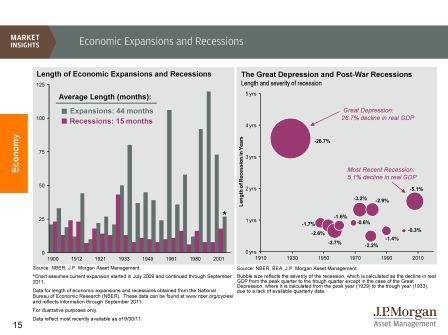
Warren Buffet is famous for saying, “be fearful when others are greedy and greedy when others are fearful.” And consumer sentiment has been down for quite some time but Warren Buffet, he has been very bullish, he’s been very optimistic on things going forward. And I just want to put things in perspective. Right now the unemployment rate is about 8.6 per cent but I think we probably all know someone who is either unemployed, been unemployed for a long time or is underemployed. And that means someone who would really like a full time job but really is only working either part time or they would like a full time job but they are at the age where they just decide to retire a little bit early. So they leave the labor force. And so the way those numbers work is if you are part-time or you’re discouraged and leave, go back to school, get more education or you retire, you come out of the available work force. And so, I think unemployment is something that really is a problem. It’s probably going to be a problem going forward but I want to provide some context as it relates to recessions and expansions. You’ve probably heard that this is the worst recession, the great recession, the worst since the great depression, and that is true. As a percentage, but I want to put some context on it just as a magnitude.
Hopefully, there’s a chart that’s up on your video there, if it’s not there, that means that my compliance department wouldn’t let me put up any of my charts here, so I’m doing two versions of this video- one with chart overlays and one without. But that being said, if it’s not there, let me talk to you about it.
The Great Depression had a twenty-six, almost twenty seven per cent decline in real GDP. GDP is the gross domestic product, kind of the national income. And most recently, we’ve had a five per cent decline, not twenty-six or twenty-seven, but five. And as a matter of fact, if you add up all the recessions we’ve had since the great depression, they’re about what we had in the Great Depression itself. So just to provide some context, it’s actually relatively small even though the negative five per cent is the biggest one since that huge number in the ‘30s. But the average length of an expansion is forty-four months, and the average length of a recession is fifteen months. And technically we are not in a recession right now. Although it doesn’t feel that way- I know that!
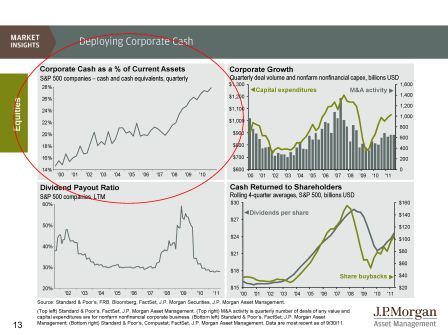
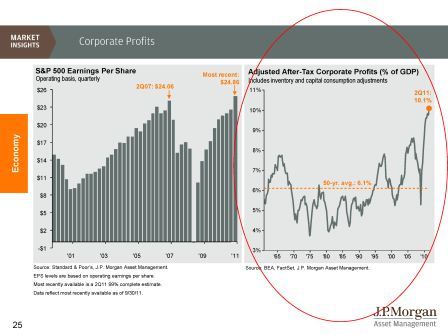
Corporate cash: corporations are holding on to a lot of cash at this point. They had, as all of their kind of short term assets, their current assets, back in 2000, about fourteen per cent of their current assets were held in cash. Today that’s about twenty-eight per cent. As a matter of fact, just since ’08, it’s gone from twenty to twenty-eight per cent. (See chart inlay.) Apple’s got over 70 billion dollars in cash. And so the corporations themselves are getting stronger, it’s that simple. Their after tax, corporate profits are over ten per cent at this point. And so that was negative just a couple of years ago and right before the huge crisis of 2008, 2009, it was not even nine per cent. So this is really at a high for corporate profits, after tax corporate profits. And so we just have to keep that into consideration.
They’ve got this cash, kind of on the sidelines, waiting to redeploy it into research and development and to purchase other companies and expand their businesses when the opportunities are ripe. When they also know that the demand is going to be there for their products. So it’s a kind of a wait-and-see, they don’t want to do it too quick because then people can’t buy their products or services. But they can’t be too late because they want to be there, sort of “just-in-time” when the right ingredients are there.
That’s what I’m thinking about this week. There’s just a few more things I want to talk about that are actually a little off-topic.
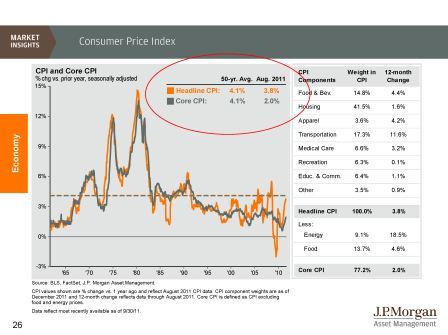
The Consumer Price Index, the CPI, is …, a lot of people talk about it being three per cent, 3.2 per cent, for the last fifty years, it’s actually averaged 4.1 per cent. I mean, it’s been hugely high, you know, fifteen, sixteen, seventeen per cent. Right now it’s very low at about two percent on the core. But the average is about 4.1 per cent, which is higher that a lot of people talk about when they are doing their retirement plans.
The end of the year is coming up as well, so the last thing I want to leave you with is: you can do IRA distributions to a charity this year, all the way up to 100,000 dollars. And it’s hopeful that the law will be renewed for next year, 2012, but it’s not guaranteed. So if you have an itching, you know, to do some IRA contributions directly from the IRA right into a charity without it counting as taxable income then give me a call and I can talk to you about that. I really would love to help you out in that regard.
Sorry it’s a little disjointed today but I just had some stuff I really wanted to talk about so I really, really hope you enjoyed the video.
Mike Brady, Generosity Wealth Management; I believe that money can and should do good things for you, your family and the causes you believe in. My phone number is 303.747.6455. I am comprehensive, a full service wealth management service for my clients and I’d love to talk to you if; I love my clients, if you’re looking for something like that or if you’re my client it’s getting to the end of the year, beginning of next year, I know we’re going to be talking, kind of structured as we do our annual review, here very soon. We talk throughout the year but this is a time where we really get together so I know we’ll have lots of conversations going forward. Mike Brady, Generosity Wealth Management and I will talk to you next week. Thank you. Bye bye.
It’s my belief the volatility we’ve seen in the past few weeks, months, and year will continue going forward. I also believe that more active management may make sense to take advantage of this market condition.
I talk about this in my video.
I also discuss the rising healthcare costs in your future and that I have software that will estimate what lump sum you may need upon retirement to fund your healthcare under certain assumptions.
Fun stuff! Click on video to hear more!
TRANSCRIPT:
Hi there, Mike Brady with Generosity Wealth Management, here in Boulder, Colorado. And I am really pleased to be talking with you today and there are a couple of things I want to talk about today.
And the first one is volatility. On Wednesday, we had a DOW that was over 400 points up, and this is following the Thanksgiving week where the market was sharply down. (Low volume but still sharply down.) And it’s my belief that this type of volatility, and not just in the last couple of weeks, we’ve seen a lot of volatility in the last year or so, I believe it is going to continue going forward. And if that is true, it’s also my belief that some active management should be considered for client’s portfolio. That’s something that I’m going to be talking with my clients about in the coming months. That’s also something I’m going to be talking about in these videos in the coming months, that it may have a place in a volatile environment- how can we best position our portfolio to take advantage of that particular market condition? So, if you’re not one of my clients, I recommend you give me a call so that we can talk about it, kind of one on one, and your personal situation.
And the second thing I’m thinking about this week is well, healthcare costs; and specifically as it relates to retirement.
I heard a statistic yesterday that is very interesting. The Fortune 100, 91 out of the Fortune 100, in 1985, had traditional pension plans. Today, the Fortune 100, only 19 of them have traditional pension plans. If you’re a GE employee, starting today, you know, day one of your employment, you are not offered their traditional pension plan. And that is, GE is one of the largest companies, with the largest pension plans. So, I think this is a trend that is going to continue going forward. And what this tells us is that you’ve got to take control of your saving and investing for your own retirement. Don’t assume that someone else, either some big corporation or even Social Security is going to handle it. You’ve got to take control of it!
And one of the largest expenses you’re going to have in retirement are your health care costs. And fifty-three per cent of individuals recently polled couldn’t even estimate what those health care costs are. We’re talking Medicare A, and B, and D, and your estimated premium payments, and your estimated out of pocket expenses. These are some expenses that you’re going to have to, you know, pay in your retirement. So the question is, in your life expectancy, what are they going to be, what kind of a lump sum, under certain assumptions, will you need to have in retirement? And of course the question is- do you have that set aside? You may, you may not, but let’s try to quantify that on a piece of paper.
I have some wonderful software that I’m going to be working with clients with in the next couple of months to try to put that number down on a piece of paper so that we can say, “Boom! This amount of money is what, under these assumptions, we’re going to need for the healthcare costs for the rest of your life.” So the question is, have you done that for yourself? Maybe you have. If you haven’t, give me a call I can try to help you answer that question. It’s a hard number to really put down, things are always in motion, but you know what, let’s try to estimate as best we can. An estimate is better than not having any idea at all. And it is something we can revise as the years go forward.
So anyway, that’s kind of what’s on my mind this week. Mike Brady, Generosity Wealth Management, 303.747.6455, here in Boulder, Colorado. A comprehensive, a full service wealth management firm; I love my clients, I have a great passion to treat my clients like members of my family, and if you’re not my client, I’d love to talk to you about whether it makes sense if what I do is right for you, or if I’m the right person to help you with that. So, anyway, you have a wonderful week and we’ll talk to you later bye bye now.
What an interesting month! Who would have thought it would turn out to be such a good month just a short 3 to 4 weeks ago? Many people actually, if you seek out alternative voices to that which you see in the daily paper or newscast. I talk about this in this week’s video below.
Also, I talk about how you should assess the level of communication in the past 2 to 3 months from your adviser. Did you hear from him/her? You sure as heck should have.
Lastly, now is a great time to get back to basics.
Click on video to hear more.
GWM- Video Transcript- 28 October 2011- Information, Communication, Basics
Hi there, Mike Brady with Generosity Wealth Management, here in Boulder, Colorado. It’s been a few weeks since I’ve done a video and sent a newsletter out. But my last video was about fifteen or sixteen minutes, and that was pretty long compared to my previous ones but I had a quarterly review and lots happening in the third quarter.
Today I’m thinking about two or three different things; the first one is information, the second is communication and the third is kind of getting back to basics.
Let me tell you what I mean by that; information. Three, four weeks ago, let’s not kid each other, you could not open up a newspaper or a magazine or watch, you know, some nightly news telecast without it all being negative. “If it bleeds, it leads.” And one of the responsibilities, I believe, of an investor and your financial advisor is not to get into a bunch of group think. I remember back in 1999, early 2000, when the internet boom was going on, if you poopa’ed any kind of an internet stock or tech company- you were just like “old thinking.” I remember Warren Buffet back in in 1998, 1999, was at a big conference of some type and yeah, there were all these internet people saying “oh God, he’s old thinking” “he needs to get with the new economy.” And, you know what, that took courage on his part, (of course he had a few billion behind him) to say “listen, I believe that your analysis is incorrect.”
Well frankly, three or four weeks ago everyone was saying the market stinks and the economy stinks, and there’s no way that it can go but down. And, that’s just not the case. I’m glad that the last quarter, excuse me, the last month has been a good month. Do I know exactly where it’s going to go-if it’s going to continue on its upward trend, is it going to reverse and go back to the down? No, I don’t. But I say that very humbly. And I watch things very closely. And I’m going to continue to have the right percentages.
I am going to next week, (assuming nothing major happens), in the next week or so, I’m going to do a video that I did about two or three months ago on information and confidence in your information. I did the video, and then so much stuff was happening in the month of August that I kind of had to put it in the can, I had to kind of put it to the side. But I want to do that because it is so relevant. I just listened to it before turning on this video, my camera here and I think it’s great and I’m very excited to share that with you.
Second thing is communication. A financial advisor sure as heck should reach out to clients and sure as heck should have been communicating with you. Because if you only hear from a financial advisor when things are going well, that’s a problem- in my opinion. You pay a financial advisor to help you, to set up a plan to hold your hand, you know sometimes, in the difficult times.
If you’re my client, you know that I gave you a call; that I reached out to you and that you’ve always got these videos and blogs and newsletters.
The last thing that I want to talk about is getting back to the basics. You know, I’ve always talked about estate planning, and tax planning, retirement planning. These are absolutely the core, essential pieces of what you should be doing for yourself. The market is going to go up, and it is going to go down, OK? I’m just telling you that. Up, down, sideways, three ways the market goes. And reassess for yourself how you felt this last quarter, and did you completely want to go off and completely change everything? No! (Hopefully not.) You need to have a plan, yes it needs to be modified accordingly, but hopefully you’re in partnership with somebody who will help tell you when “wow, we need to radically change this,” or only minimally change it, or maybe do nothing. That is proactively doing nothing is still doing something, OK? And so make sure that you get back to the basics; is your portfolio in line with what your risk level is? I think that’s absolutely essential and that’s some of the best advice that you can get.
Now I believe going forward that we’re going to have, so maybe I’m thinking of four things (!), I think we’re going to have some volatile markets and this is an opportunity for some tactical allocation, some dynamic asset allocation. So one of the things that I’m going to be talking about in the next quarter or so, for clients, is how that plays into your portfolio.
I think there are certain markets where this is… where having a more actively managed portfolio makes sense. And I think going forward that is going to be the situation because we’re having various trading ranges, increased volatility and lots of range trading and ex cetera.
So, anyway those are some of my thoughts. I guess it’s not quite as short a video as I thought. Sorry about that. But well, you could have hit pause at any time during this video!
Anyway, Mike Brady, Generosity Wealth Management, 303.747.6455. I would love to hear from you. If you’re my client I absolutely love you. If you’re not my client, I like you, but I’d love to get to love you. So please give me a call, or an e-mail; mike@generositywealth.com.
But anyway, you have a wonderful, wonderful day and a wonderful week, and we’ll talk to you later bye bye now.