A puzzle that was so hard the first time around is simple in hindsight.
This is known as Hindsight Bias.
This week I talk about the psychological phenomenon of Hindsight Bias and investors’ over reliance on Performance Numbers.
TRANSCRIPT:
Hi Clients and Friends, Mike Brady here. This week I want to talk about Hindsight Bias and why many investors put an overemphasis on past performance. I mean if you’ve been an investor for some time, you’ve probably had that experience where you find a mutual fund that’s had a great track record for three, four, five years, or so, you put your money in then all of the sudden the track record goes right down the toilet. You take it very personal, and I’m here to tell you it is not personal. That person probably put an overemphasis on past performance.
Now, hindsight bias is a group of distortions that are created when we have knowledge of an event that has already occurred. When we remember the past we find it impossible to remember all of the uncertainties that were facing us at the time. We remember a reconstruction of past events based on what actually happened. It makes it seem so much more inevitable, the actual occurrence that happened. Have you ever had that puzzle or that riddle that was just impossible to figure out, and then you figured it out. And then it’s like, “oh, that’s child’s play, that is so very obvious!” Well, you forget that at the time it wasn’t so obvious. It is the same thing as it relates to a kind of a hind sight bias.
Now, in general, I’m going to philosophize here a little bit, I believe that humans and people, and investors, we don’t like uncertainty. I mean, the more uncertainty there is, it kind of reminds us how little we really know. It is very discouraging to understand and to realize how limited our understanding of cause and effect really is. Sir Isaac Newton, talked about cause and effect. And it is very hard for us to understand that sometimes things happen without a very clear cause. And we are always looking for that exact cause to correlate with that effect. And the world, I’m kind of a chaos theory proponent, that the world is a very complex place. And so we’re always looking at a past performance, we’re always looking at data in order to reduce some of our uncertainty as we go in to a particular investment.
There is another study, just kind of talking about from a behavior science point of view, that the more data we have makes us feel better but doesn’t necessarily make the decision we make that much better. There’s one study after another that has shown that. And so what I would recommend is to really talk with that particular manager to find out how he or she makes decisions, how they think, how when some adversity some problem comes before them, how do they approach that problem? What’s their knowledge in the field that they are managing in? They’ve got to be absolute experts in it. But I would also argue, now I’ve said this in previous videos, they’ve got to have a sense of humility. A sense of humility about what they do know and what they don’t know; what are the certainties and what are the uncertainties- an ability to be comfortable in that unknowing place.
That is my discussion this week on the bias and also on past performance- about avoiding putting too much emphasis, almost as if it is a given “past performance guaranteed…future results.” It’s just not true – it’s not just a catch phrase at the disclaimer at the back.
I am a registered representative with Cambridge Investment Research. My company is Generosity Wealth Management. Phone number is 303.747.6455. You have a wonderful week, talk to you later, bye.
John Paulson, a smart, rich, and successful hedge fund manager, has some pretty good words about “Risk” in a paper he recently published.
Put simply, you have to understand what the Risk is before you come up with bumper sticker phases like “if you watch the downside the upside takes care of itself”.
The tsunami that hit Japan last week and has affected their nuclear reactors is causing great concern in the stock markets.
The Nikkei dropped 11% a few nights ago. The US markets have dropped 2% this morning (Tuesday as I write this).
Now is the time to determine if you’re gambling or investing?. Is this an emotional sell off or a harbinger of things to come?
I discuss Emotional Selling in my video this week.
TRANSCRIPT:
Good Morning Clients and Friends, Mike Brady here.
This week I want to talk about emotional selling. The tsunami hit Japan late last week. I’m recording this on a Tuesday morning and overnight the Nikkea went down 11%. It is just absolutely getting killed. Our markets have opened up very sharply down. So the question I’m posing is what do you do in a situation like this? If your first inclination whenever a huge catastrophic event happens, and now we’re trying, and looking and waiting for what’s going to happen with these nuclear reactors, is if your first reaction is to sell, “I’ve got to move right to the cash!” Then you might ask yourself, are you gambling or are you investing?
What I look for, and if you watch some of my videos, particularly my beginning of the year video (hopefully, you’ve watched it time and time again, it’s must watch) that we’re looking at months, weeks, and the year, of what the market is doing; the value of it, the quality of the market. Because there always going to be events like Japan right now, is happening. I don’t want to minimize the impact of what is happening there in Japan. Japan is a huge global economic player and what is happening there is absolutely horrific. So please, don’t take this the wrong way- that I’m trying to minimize it.
But I am looking at historically, there have been huge events- in our most recent times, the last 20 years or so, there’s been Gulf War I, there’s been Gulf War II, there’s been 9/11- where the market really went down. When the markets reopened that, you know, the week after, and the quarter ended up being positive; the next quarter after that.
So, you know, the major impact that this is going to have, I don’t know yet. I absolutely acknowledge that I don’t know and anyone who says they absolutely know is pulling your leg.
What I will do is to continue to watch this very closely. I do not get emotional about it. You know, emotional selling I think, doesn’t serve anyone’s best interest. I might change my mind in days, in a week, and in a month. That is why you can’t be beholden to your theory, you know, so very stringently. But you do have to kind of keep a straight arrow. What are you doing? What are the value of the market? What’s the impact going to be, not just the immediate impact but one month, one quarter and one year from now? And, with all the data that I have right now, as it’s being compiled, etc., I’m not convinced that now is the time to sell out. So I’m not doing anything with my portfolios for clients. But you know, I will continue to keep you abreast that’s why I have weekly newsletters so you can know what I’m thinking.
Anyway, I just wanted to kind of touch base on that. Hopefully, you’re getting this video, I’m doing this on a Tuesday morning, getting it a little late to my compliance department. And hopefully they’re really good about getting it turned around so you are getting this on a Wednesday morning. If not, you’re getting it as soon as possible.
So anyway, have a wonderful week. I’ll keep you informed.
My company is Generosity Wealth Management. I am a registered rep with Cambridge Investment Research. 303.747.6455. I am here in Boulder. If you’re my client, I love you. If you’re not my client, I still like you but I’d love you to be my client. 303.747.6455. Thanks bye bye.
The article I link to below expands on the themes I bring up in my weekly video. You want a double dose of “emotional selling”? You know you do. Click on the link.
Don‘t forget the unexpected happens. The “Peace Dividend” after the Berlin Wall (quite a euphoric event) saw the next 2 years in a stock market recession.
After 9/11? 6 year stock rally ensued.
It is uncertain the long term effect of the Japanese troubles. Let’s not make long term decisions based on short term emotions.
That’s what separates the amateurs from the pros. Be a pro.
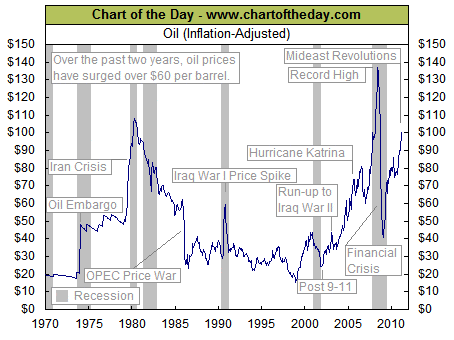
Oil has been one of the big pieces of news recently, with some forecasters predicting much higher prices at the pump, whereas others are predicting a stabilization and downward trend as other countries start to increase their output.
The price of oil is important for our economic recovery, and if prices continue to climb, this will not be good. A higher oil price can negate all the progress we’ve seen so far.
To the right is the historical price of oil. Let’s not forget we’ve been here before and survived.