The 2nd Quarter 2011 is over and I have a slightly longer video this week because I include my preview for the 3rd quarter.
I talk about what I think of the current economic environment, bucking the trend on some of the pessimism I hear and read about so much anymore.
I send my newsletter and videos on a weekly basis, so if you watch only a few througout the year, at least watch my more comprehensive quarterly videos.
Click to watch
TRANSCRIPT:
Hi! Welcome to the Generosity Wealth Management Video.
This video is the second quarter review and the third quarter review. I’m going to try to spend most of my time on the preview because no matter what we do, we can’t relive the second quarter. Hopefully we can learn from it but we can’t redo it.
The second quarter for the stock market indexes- if we were, if the quarter had ended a couple of weeks earlier then we’d be saying “oh man, what a horrible quarter!” But well, it ends on June 30th. And the last week of June was a nice pop-up in the equity markets. All of April was pretty good, going into May, and then we just hit a big slide. For about six weeks all through May and June, except for this last week in June; relatively low volume though, on the exchanges. Bonds were just kind of chugging along through the quarter until the last week and the last week was a really bad week for the bonds. I think what was happening, is with Quantitative Easing ending, a big buyer of bonds, that bond holders were like, “wait a second! I don’t want to be the greater fool, holding these bonds. The demand for these bonds is going to be less and so I’d better get rid of them now.” And so, they got out of them and moved into equities.
Now let’s talk about the third quarter for just a second. I want to tell a little bit of a story about emotionality. There were mythical creatures called Sirens. And they lived, this is a Greek story, with Ulysses and the Sirens. And the Sirens lived on these islands and they had this beautiful music, sailors would become enthralled with the music, want to go toward the Sirens with their boats, where the rocks were, they’d hit the rocks and get a big hole and the boat would sink. OK, bad stuff. But Ulysses, he really understood this, but he really wanted to hear the beautiful melodies that he’d heard so much about. So what he did is he gave wax to the sailors on the boat that he was on, and said “put this in your ears and tie me to this pole” (that was on the boat,) “and no matter what I do, don’t untie me.” So they got close to the island, Ulysses was able to hear the beautiful melodies, he went stark raving mad, but because the sailors had the wax in their ears they didn’t hear it. They sailed away and they were just fine.
Now, Ulysses’ plan saved his life and the lives of all those around him because he had a plan and his foresight and his non-emotionality about it was, is really kind of something to be admired; and kind of the lesson in the story.
So why do I say that? Right now, it is very fashionable to be “bearish;” to be down, you know, on the economy and the recession and investments and the world is going to end. I mean I’m on a significant number of blogs and things that I read, and it’s very fashionable to say “You know what? Armageddon is right around the corner!” And I was just, two – three nights ago, at you know, a social gathering and it wasn’t “is it going to happen?” but “when is it going to happen?” They are actually trying to argue and pinpoint the actual month that the 2008 crisis is going to hit again.
You know, I listen to all that data. I look at yield curves, both in the U.S. and in others countries. I look at the various data that keeps coming out. I look at the balance sheets of companies to find out what their cash balances are and what their profit abilities are.
I listen to what’s happening over in Greece. Which, if you’re not paying attention to that whole Greece debt and austerity plan, and then, kind of, the bail-out, you’re missing good stuff! I mean that is just fascinating- it is better than any Jerry Springer show you could imagine.
So I have to talk all the stuff into consideration and I have not moved from my analysis six months ago, that this will be a positive year, 2011, for the equity markets and for the bond markets. And how positive it’s going to be? I don’t know. But you know what; I am still going to have a position in the equity markets. I am still going to be modestly positive in my outlook for this year.
When I look at the yield curves of the kind of, the other countries, you know; the Brazil, and Russia and India and China, some of the not quite developing countries; but not quite the been-on –the-world –stage –for a very long time like Japan, Europe and the United States; I, they have a curve that is going from normal to flat, to inverted. They are about flat right now. And that causes me concern. That will not bode well for them so I want to be more U.S. If we are relying on an awful lot of the growth going forward on these various countries, and so if they start to go towards a recession, then that’s impact us, and, here in the United States. But that being said, I think that we’re more willing and ready and able to handle that.
Particularly, since when you look at the cash positions of corporations it’s actually quite large. When you look at the profitability of corporations right now, they’ve gotten rid of, kind of, the “fluff;” kind of the efficiency. Now when I say “fluff” please don’t call and e-mail me with bad things saying “oh, wait a second, they got rid of a lot of people, that’s not fluff!” No. They did get lean and so that’s a good thing going forward even if there might have been short term, some pain, that they might have done in their own austerity measures. And so, I am continuing to be kind of mildly bullish, when most people that I have around me that I talk to are from mild-bear to full-blown “Armageddon is right around the corner!” I’m just not in that camp.
I still feel that bio-tech is going to be the next big thing in the next ten years. I continue to think that gold is something to be considered. And so, if I’m wrong, I believe that gold will dampen that wrongness. Because at the end of the day, nobody knows the future; I certainly don’t know the future. So what I’m going to do is I’m going to try to have a wise diversification, not a naive diversification; transparency, and of course communicate and keep the expenses as low as possible; because they can, of course, can drag down any kind of a portfolio if you have too high of expenses.
Anyway, I am not making any major changes for the third quarter. I’ve had an opportunity to go through all of the statements for clients. They were actually mailed out on Saturday. So hopefully clients have gotten them already either; Tuesday, Wednesday or Thursday of this week. But I’m not making any huge, major changes.
I will continue to have my video so that you know what I’m thinking about because if the data changes, you know what, my opinion might change. I have an opinion more than just once a quarter when I do my quarterly review and preview.
Anyway that is where I am right this second. I encourage you to give me a call if you would like or an e-mail with any thoughts or refutation of my conclusions. I am, my business is growing- I’m actually very proud of that, and so if you know of somebody you feel I should speak to who would like some guidance, you know, I’d love to talk with them, 303.747.6455. My name is Mike Brady. I am the President of Generosity Wealth Management. And I have a couple of disclaimers here at the end that you should definitely stay tuned for. But in the meantime I hope you have a wonderful week, I hope you have a wonderful quarter and I’ll do another video in a week. Talk to you later, bye bye now.
I’ve been talking about the problems with the PIIGS (Portugal, Italy, Ireland, Greece, and Spain) for over a year now. Greece in particular has been very prominent in the news recently.
Has this been a slow train wreck? Yes. Has our investment markets continued to go up during that time frame? Yes. Will our markets continue to go up? That’s always the question, and a harder one to answer. One of the things I’m trying to do is guide you and my clients to that answer, knowing of course the future is unknown.
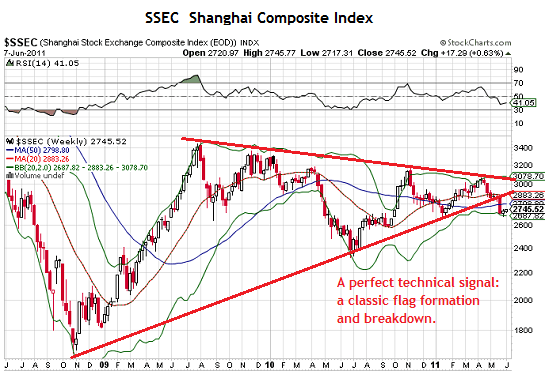
Anyway, this week I discuss what I believe is another bubble ready to burst–China. I’ll be following up over the summer with technical reasons why structurally and euphorically (if that’s even a word), China is someplace to be cautious.
TRANSCRIPT:
Hi Clients and Friends, Mike Brady here.
This week I’m thinking about some of the similarities between China, right now, and the U.S. right before our stock market crash in the late 20s, frankly. So does that mean that I think that China is going to have this huge implosion? No. Do I think that China is a bubble? The answer is absolutely yes. Tread lightly, as it relates to China.
One similarity is just a massive disparity between, in income, and in wealth, and in education; China now, the United States back in the late 1920s.
There’s the rapid industrialization; huge boom in the last 10 to 15 years in China, very similar to the rapid industrialization in the United States.
Opaque and misleading economic data and fiscal data- very big similarity. Massive buildup of leverage amongst the rising class. Credit and leverage is, has, had increase significant in China just like we had in the 1920’s.
And kind of the last thing, is bubbles, in both residential real estate and infrastructure. What they have done, they being China, in the last fifteen to twenty years is just unbelievable. But this has also led to an incredible infrastructure bubble and real estate bubble over in China. And when that thing bursts, we just saw it back in 2008; it can have some pretty dramatic effects on the economy and on the stock market. And that’s what I’m greatly concerned about right now.
I haven’t really thrown out a bunch of statistics and reasons for why I’ve come to these conclusions. But if you want to give me a call and I’d be happy to talk to you about them, 303.747.6455. My name is Mike Brady; my company is Generosity Wealth Management.
The reason why it’s called Generosity Wealth Management is I believe that if we put together some of your investments, and your tax and your retirement, and your estate planning; all these kinds of silos together that you can start to be generous with yourself, your family and the causes you believe in. I want to help you learn to be generous. So I am a registered representative with Cambridge Investment Research. And you have a wonderful, wonderful week and I’ll talk to you later. Bye bye.
I’m a big fan of Warren Buffett (as many of you know) as I admire his intellect, drive, and humility. There’s a reason he’s in the top 5 richest in the world.
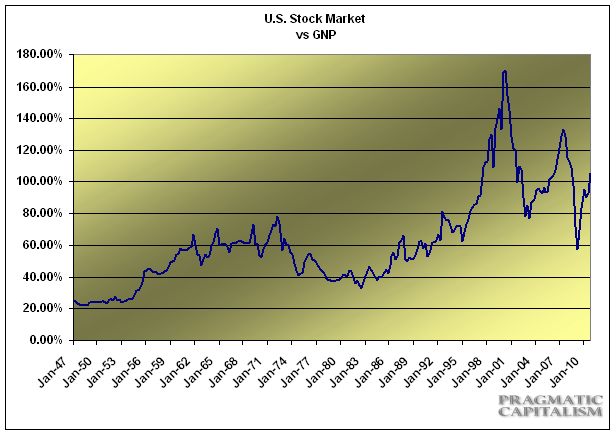
Warren Buffett has a chart that he’s described as his favorite. It’s the total valuation of the stock market versus the Gross National Product of the US.
What is it telling us now? A = Stocks are modestly expensive.
Should you sell everything to cash? A = No. It does, however, tell us to be very cautious going forward and watch the percentage we have allocated to the equity markets.
Do you know what the percentage of your portfolio is exposed? If not, please contact me and I’ll do what I can to help you out.
Oh, and in case you’re curious or a compliance officer, the Shanghai Composite Index is an index of all stocks (A and B Shares) that are traded at the Shanghai Stock Exchange. It is merely being used as a proxy for the stock makret and cannot be invested in directly.
The stock markets have been making some headlines recently. Last Friday, the DOW declined below 12,000.
Should you freak out? Is this the beginning of the end?
I also address whether I feel the gold rally will continue. Does it make sense to be a part of your portfolio?
TRANSCRIPT:
Hi Clients and Friends, Mike Brady here.
Just a quick video just to let you know what I’m thinking about this week. And this week I’m thinking about, sort of, the news headlines about the kind of, the steady erosion in the Dow and the stock markets, the equity markets, over the last week and a half to two weeks. The momentum has certainly slowed, but is this something you should freak out about, and completely sell all your stocks, and this is the beginning of the end? I don’t believe so. An official correction in the market is when you hit ten percent, and we have not hit that.
As of the recording of this video it’s down about six and a half percent from its high. And you have to ask yourself if this is, you know, completely impacting your portfolio, maybe you have too much in equities and stocks. So this is a good time to evaluate whether or not you are getting the full force of that, the extent of that decline. And if so, then you probably have too much in your in your, too much equities in your portfolio.
I do believe that diversification is a very key ingredient. The last couple of years we’ve had a pretty strong, upwardly mobile market with a couple of declines here and there; and most notably last summer in July. But pretty much it’s been up, up, up. And so something like this makes great news headlines.
I’ve been asked in the past if I think that gold is a good compliment to your portfolio- and the answer is yes. Gold has had a huge rally over the last few years. And one of the reasons why, there’s three reasons why I think it’s going to continue to be attractive and a nice hedge, a nice part (a relatively small part) but a part of your portfolio.
Number one is I think low real interest rates world-wide still make it attractive. I mean, real interest rate means what you are getting after inflation. So if your rate of return is five percent and inflation is four, then your real rate of return is the difference which is one percent.
The second reason why gold is going to be attractive is some fiscal concerns, highlighted in you know, continued fiscal deficits. And so, I think this is something that is a real concern and what makes gold a little bit more attractive.
The third thing is just emerging market economics. It becomes, as emerging markets world-wide, globally, people…, it becomes commodity driven, and people in those areas do want some gold and some inflationary…some protection against inflationary pressures.
I think of, whenever you’re looking at which asset class to go towards, whether or not it’s stocks or bonds or gold, or whatever it might be; it’s like a beauty contest. It’s not always what you think is the most beautiful but you have to think about what everyone else thinks is the most beautiful. And I do think that gold is something that everyone finds very attractive. And so we always have to evaluate do they still think it’s attractive? And we have to be smarter than them about that.
It’s the same way with the momentum of the equity markets, the bond markets, whatever it might be. And so, I think that this summer it is going to be choppy as it relates to the equity and the stock markets. We’ll continue to evaluate that. Do people, getting back to my analogy of the beauty contest, do people still think that it’s attractive? But I think, you know, some of the profitability of the underlying balance sheets of corporations etc., make it attractive to me, and I have to continue to watch to make sure that it’s attractive for other people, to other people, if they are seeing it the same way that I’m seeing it.
So anyway, that’s, those are my thoughts. That’s it for this week. My name is Mike Brady, my company is Generosity Wealth Management. I am a, kind of a holistic comprehensive approach with clients, with their financial well-being. Give me a call, 303.747.6455. I am a registered representative with Cambridge Investment Research. You have a wonderful week and I’ll talk to you next week. Bye bye now.
One of the big drags on the economy in the coming years will be our fiscal deficits and budget problems.
I’ll be writing this summer about the US ability (and struggles) to sell bonds and finance the debt, particularly as QE2 ends and the Chinese bubble bursts (at some point in the future).
This article talks in depth about an issue we may see more of in the future–US debt being downgraded. This is from a German, not US, rating agency, but it could be just the beginning.