I’ve met with literally thousands of people over my 21 year career.
Many people have asked “how can I be rich?”.
The question is so difficult to answer. Besides the obvious “win the lotto” and “hope you inherit tons of money”, most of us will increase our probability of reaching our goals if we simply spend less than we make, save religiously, invest wisely, and avoid catastrophic financial events.
Your ability to make saving a habit is one of the first steps.
Perhaps you’re already a good saver.
Whether you’re a great saver or wish you could be better, I encourage you to click on the below link for some great tips.
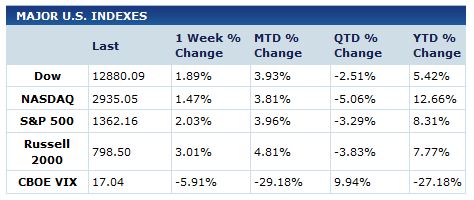
Much of the unmanaged stock market index gain for 2012 was in January, April, and June. May was brutal.
In my opinion, you must have a well diversified, long term strategy for your portfolio and for reaching your financial goals.
Do you have a plan and strategy you’re comfortable with? If the answer is “no” in any form, I encourage you to call me so we can discuss what needs to happen in order for you to emphatically answer “yes!” to that question.
Full Article on Winners and Losers for the 2nd quarter at the link below.
Sorry in advance for a longer than usual video this month (7.5 minutes), but I have some charts and graphs in there to provide some context for the slow ride down in the un-managed stock market indexes that we saw for May.
The question we always have to ask ourselves is “what is this telling us?” and “what does this mean for the future?”.
Click to watch my video.
TRANSCRIPT:
Good morning, Mike Brady with Generosity Wealth Management speaking to you from Boulder, Colorado. And today I want to talk about what’s been going on in the markets; what’s happening in Europe, how that’s affecting things in the United States; kind of the United States by itself. But really, kind of what’s happened in the markets in the last month or so. I mean the unmanaged stock indexes in the last month or so are down about ten per cent and this is the third time in twelve months that we’ve seen within the space of a month a ten per cent decline, or so.
One thing that makes this May different is that it was a kind of slow steady decline versus lots of volatility. I mean if we look back to just last summer, remember when there were four and five and six hundred point swings on a daily basis. We just didn’t have that this past May.
Unfortunately, the last month has wiped out some of the gains that we had accumulated in the first quarter of this year. Just to provide some context the markets are actually still positive for the year, the unmanaged stock market indexes. So, the question you might ask yourself is, OK, we’ve had low volatility in May, it’s been a decline in the month. The optimist in you might say, well, the market is reading this, the market has actually done quite well over the last three or four years since March of ’09, and this is just kind of a step back, and it’s reading the market and it’s not freaking out. The pessimist in you might look at Europe and all the bad news there, how is that summer of discontent going to affect the global markets, the U.S. markets and what’s going to happen with the European Monetary Union, our continued bad job markets throughout the summer leading up in to the election etcetera? And say, “Wow, this is just the beginning. I’m looking at a big crevice before us, I’m looking at the abyss and I certainly don’t like it and I feel uncomfortable with it.”
One of the reasons we have long term diversified strategies, and hopefully you have one, is because that’s an investment, a conscious investment, in the future, saying that “I’m going to take three steps forward and one step back.” Maybe five steps forward and three steps back, however it is. But over the … why would you invest in something if you believe that long term that it’s not going to be greater in the future than it is now? Now I could sit here and show all kinds of studies which show that having exposure, having a well-diversified portfolio, is in the investor’s best interest as you’re reaching your retirement goals or as you’re in retirement, maintaining your principal and some income going forward.
But as we look at that, I’m going to throw up a chart here, on the screen and what you’ll see is intra-year declines are something that have always happened. And it’s not uncommon for there to be double digit returns. I’m going to circle a couple of them up on the screen. But what you’ll see is that does not mean that the year ends negative. So don’t write off this whole year just because it’s June and the markets, although they’re only slightly positive they’re not double digits or maybe what you would like. And so there’s more than fifty per cent of the year before us even though May has not been very favorable.
I happen to be a contrarian at heart and one thing that…, I’m going to throw a chart up here, is the equity allocation, the recommended equity allocation when it’s very high percentage, you’ll notice that it is kind of market tops, there at about 2000. A lot of times when people do not want to have an equity allocation, like March of ’09, is exactly when you want to do it. Let’s keep it in perspective that since March of ’09, the market, as of last quarter was up well over 100 per cent in an unmanaged stock market index.
One thing that you want to consider as well is having a very well diversified portfolio, including bonds both government and corporate. They have a tendency to reduce your volatility, of an individual portfolio. That’s why you have an asset allocation. That’s why you have a diversification. But you make various “tilts”, I might say, throughout the year. And that’s what I do on my clients’ behalf.
So, let me summarize here real quickly; the market in May has been very difficult. The question we have to ask ourselves is, “what does that lead us, what conclusion does that lead us through the summer and through the rest of the year?”
I stand by my conviction, which I gave at the beginning of the year, this is going to be a positive year. And the reason why I do that, even with all the negative information out there, OK, I hear it OK? And I certainly hope I don’t give off the impression that I’m stubborn. It’s like, “No, no, Mike won’t… data’s changing and he’s not changing.” Which at my last video I said, “Hey, I’m really concerned about things going forward.” And I think I was right in the last two or three weeks or so that there has been a weakening. But the reason why I am optimistic is still because of the strength, as I see it, in our companies that have fortified themselves against very uncertain times and some bad information going forward, OK?
If I am wrong, that’s why we remain diversified. And that’s why we keep our eye on the long term goal and have diversification, OK? You’ve got to have a good portfolio. But that being said, I don’t think I’m wrong. Why would I say something if I thought I was wrong? But I also have to have the humility, and every investor needs to have the humility, and you don’t bet all on one particular thing.
So, I am still optimistic for the year. I’m not changing my allocations in general at this point. I am not freaked out as in; the world is going to end this particular summer. I do believe the volatility is going to continue to be greater now than it was in the first quarter of this year. But I don’t believe, as I see it, as I do my analysis, that we’re going to see the kind of volatility that we saw last August.
There is a lot of data that’s going to come out this summer. Europe is still going to be the big news and so we have to watch that but we also have to keep it [take it] with a grain of salt; about how that’s going to affect us.
One thing that I continue to be concerned about is the coupling of Europe, the disappointing news out of Europe, and the disappointing economic, kind of macro-economic news out of the United States. I think that that’s a real disturbing trend. And of course, I continue to watch China as their numbers have faltered as well.
That being said, I’m holding true right now with the allocations that I have for my clients. If you need assistance, if you want a second opinion, I’m happy to give that to you. I certainly hope that you have a plan as well, that’s a multiple year plan about how to reach your goals and kind of live, reach your goals. Live within retirement at the lifestyle which you would like.
Anyway, Mike Brady, Generosity Wealth Management. Sorry this video’s been a little bit longer but hopefully I’ve given some good data in there as well and some good thoughts for you. Give me a call if you have any questions, 303.747.6455, and we’ll talk to you later, thanks, bye bye.
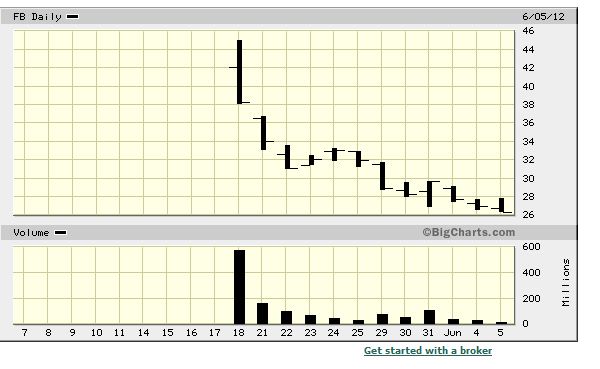
I have no idea what Facebook stock will do over the next 2 to 10 years. I hope it does great.
That being said, the above chart is the reason you don’t buy on hype or let your emotions lead your investment mind.
Be the smart money. Do your homework. Know why you buy a stock, under what conditions you’ll sell it, and be sure it’s part of a long term diversified strategy.
I’m asked periodically what I think of “market timing” or “active management” versus a straight buy and hold philosophy.
My first response is usually to ask for a definition of those terms. While it may be obvious to the person asking the question, if you ask 3 people you’ll get 3 different answers.
In this week’s video, I propose some definitions, but also share that while I think active management is preferable over your traditional buy & hold, market timing is great in theory but hard to execute in the real world.
Click to watch my video.
TRANSCRIPT:
Good morning! Mike Brady with Generosity Wealth Management and today I want to talk about active management; and what’s the role of that, what’s the place in someone’s portfolio; and frankly can “timing” be done, and done successfully?
Let me just tell you that in a previous life, a different company that I was involved in the late 90’s and early 2000’s, we were known as the market timing firm. And we were extremely successful at that. And so, I know first-hand that market timing, with the right players and in the right environment, can be very successful. However, most people cannot market time on their own. And market timing, traditionally is meant to be when to go in and out of the market, whether it’s short term; meaning a day or two or a week or even longer term; month, quarter or year; going between stocks and bonds and cash, etc. whether that’s with mutual funds, etc. That’s kind of a traditional discussion of market timing. You know, I think that those that can successfully market time are very small. But I do believe it can be done it’s just very, very difficult. And it is extremely difficult for an individual investor to do it on their own, on their own portfolio. I use an example, whenever I need some legal work done, if I try to do it myself, I’m not going to be successful. Does that mean that legal work is not successful? No. I have to go to a lawyer, someone who is trained and is unemotional about the particular problem or issue that I might have. But, as Mark Twain said, “A lawyer who represents himself has a fool for a client.” Well, what he’s really saying is a lawyer should not represent himself. So it’s very difficult when you’re emotional about an issue to handle it on your own. That’s why I think a professional adviser makes sense even if that person is doing some market timing.
I do allocations within sectors. And I’m usually almost always invested but I’m trying to weight, kind of tilt, one sector over another; whether it’s large cap, small cap, or mid-cap. What I don’t do is go 100% stock one day and 100% cash the next day, or even week by week. I think that that is a skill that is extremely hard to do and a lot of times it just isn’t very successful. I’m not sure that the environment today is the same environment that it was ten and twenty years ago.
Unfortunately, the statistics out there show that investors who try to time the market on their own are 20% less successful than if they had just done a “buy-and-hold.” (Source: Barry Mendelson, CIMA, CMC EResearch, “Dangers of Market Timing,” 4/29/2008.) And once investors become active, this study that I just read a week or two ago, says that 40% admit that they’re probably too active and that they’ve hurt themselves. (Source: Helen Modly, CFP, CWPA, Focus Wealth Management, Ltd., “How the Wealthy Avoid Behavioral Bias: 7 Strategies,” 2/13/2012.) So, I do, … I’m kind of giving a “waffle-y” answer here; I do believe it’s possible, it is extremely difficult. I believe that a better solution is probably to be well diversified and to tilt particular sectors one way or the other and be very well diversified. I do work with some good managers that I’m very pleased with their particular approach and I’d be happy to talk with you about them and the way that they manage money, not in a market timing situation but in a good active management situation where it’s deciding what are the “tilts” and the “weights” of that particular diversification.
Hopefully this video made sense and clarified things a little bit; either way, give me a call if you’d like to talk about it. I just absolutely love hearing from you and hearing from your friends. So pass it on to someone if you think that they could have some value from this video. 303-747-6455, my name is Mike Brady, here in Boulder, Colorado. You have a wonderful, wonderful week. Thanks! Bye, bye.
If you’ve been following my newsletters over the years, you know I believe in diversification and that one of the key ingredients to reaching your goals is to avoid catastrophic financial events.
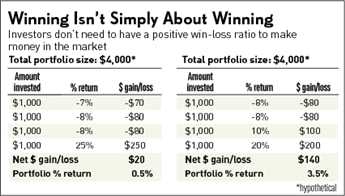
It’s important to note, as the table above illustrates, that not every investment has to make money. Limiting the size and number of the losses is important, and if avoiding any kind of loss at any time is your strategy, then you’ll always be on the sidelines.
Risk management is key, and with that it is understanding some investments will do different things at different times, and not all will be winners in each time frame. Keeping your eye on both winners and losers and replacing them when necessary is a standard ingredient in prudent portfolio management.