The Quarter in Review and Unintended Consequences
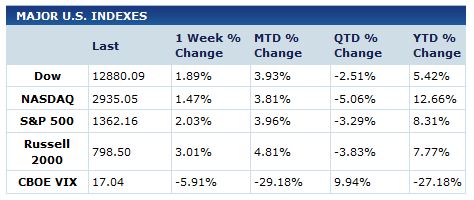
The first quarter was a strong quarter, particularly for the unmanaged US stock market indexes.
But what is going on in Europe? What might the unintended consequences be of the Cypriot banking issues?
I talk about all of this in my video, so I highly encourage you to take a few minutes and listen to my thoughts.
Graphs referenced in the video: Full Graphs
Transcript:
Good morning. Mike Brady with Generosity Wealth Management, a comprehensive full service wealth management firm here in Boulder, Colorado, and I am so pleased to talk with you this morning because we’re going to talk a little bit about the first quarter of 2013. We’re going to talk about the rest of the year. We’re also going to talk about unintended consequences, and I’ll talk about what I mean by unintended consequences in just a little bit.
First quarter of 2013, very good quarter, particularly if you’re 100% invested in the S&P 500 (which you probably shouldn’t be), and very disappointing for you if you’re 100% invested in wheat futures (which you probably shouldn’t be). Realistically you hopefully have a well diversified portfolio of stocks and bonds and cash in US and international, something that fits well with you with your risk tolerance level. If you’re my client, of course I’ve talked with you about that. If you’re not my client, well gosh darnit, you should call me so I can work with you on that.
I’m going to put up on the chart there something that might be a little difficult so I’m going to put a link to it so you can grab the high definition JPEG of it, but you’re going to see across the gamut there, from on the left you’re going to see the S&P 500 all the way to the wheat futures there on the right, all kinds of ranges from – from very good double digits in the positive to for the unmanaged stock impact indexes to double digit negatives for those – those evil wheat futures.
I’m always reminded that like predicting the weather, predicting the economy and predicting the markets, et cetera, is a very complicated proposal. No one is absolutely right, and there’s many different variables that go into it. The older I get, the more humble I become, and at the beginning of the year I said that I thought that this was going to be an up and down couple of years, that it’s going to be a trading range, and I was asked by a client last week if I was surprised by the first quarter strength and the answer is I was surprised but one quarter does not a year make. One quarter does not a two-year time frame make, and I hold to that.
I think that going forward there are so many pieces of data that are negative, there are so many pieces of data that are positive, and that’s normal. When someone says to you, if you see some kind of a TV pundit or an analyst that, well, all these, we have conflicting data. Well, there’s always conflicting data. There’s never 100% way or the other. We have to become comfortable with that type of chaos, and we I think have to take all the data in and say, okay, what does it really mean? And for me it means that it’s going to continue to be that muddle through.
One thing that does concern me from an economy point of view is it feels like a very sluggish economy. The participation rate from an employee point of view, I’m going to throw a chart up there, continues to discourage employees. That being said, I don’t take the complete pessimist view, because we knew this going back that there’s going to be so many baby boomers exiting the work force, so we knew this. Remember that book back in the early 2000s, The Roaring 2000s by Harry Dent, he talked about how around this time frame there are going to be a lot of people exiting the work force and starting to withdraw money from the market. That being said, I think that if you talk with some of your friends and family members, you probably know people who have tried to get a full time job that have decided to go back to school or decided to take something that is less than full employment or what they’re looking for, so it’s a combination of those two, and at various points in time we have a major shift change, and I think that we’re going through that right now and have been for the last two, three, four years, of what does it really mean to be fully employed? What skill levels are we as a society needing in some of those high tech and creative positions? And so that’s what we’re seeing right now. It’s always painful when we go through it, but I’m ultimately an optimist on the US and how we solve things and our ability to weather many things.
Now, I want to talk about unintended consequences. The unintended consequence from August of 2011, remember what we were talking at that point about the down grade of the US from triple A down to double A, and everyone said oh, my gosh, no one’s going to want our treasuries. Well, the exact opposite happened and people basically looked at, investors looked at all of their options and said, you know, this can have a huge impact on some of these other asset classes. I actually want the treasuries which look the best horse in the glue factory, and so that’s exactly what happened. There was a huge rally in the treasuries. I think about, and this is a slight tangent, but I think about Kenya about four or five years ago. I think many of you know that I go to East Africa for two to three weeks a year and do some charity work there, and in Kenya they had a riot after one of the elections and it cut off the whole, you know, Rwanda and Uganda from the ability to get fuel and to get other goods and services because they were coming through Kenya. Well, what was the unintended consequence of that? Now there’s a huge pipeline and rail that’s going through Tanzania that completely bypassed – they’re going to completely bypass and have as a secondary something that’s not Kenyan. That’s really going to long term hurt Kenya, who had a monopoly on getting goods and services in there.
The reason why I bring that up is let’s look at what happened with Cyprus and the European monetary union. Essentially the Cyprus banks decided to treat their depositors as investors in the bank, saying, well we’ve lost all this other money, we can’t – we’re having real difficulty, and the European monetary – European Union is basically saying well, you got us tickets to those uninsured depositors. Now, if you were a depositor of a large amount, you think that’s not going to cause some concern down the road? I mean, I think this is probably the end of the Cyprus banks there, and it also had an unintended consequence of everyone else who is looking at the investing, not investing but depositing banks and European banks is that the European Union said, you know what? This country, the next time Italy comes around, the next time Portugal or Spain comes around, or Ireland, you know, you’re on your own. It’s up to the country. We’re not unified as a European monetary union, unlike what we have here in the United States.
So I think that the unintended consequence of that is a further segregation of the banking system and financial system in Europe that’s just going to speed along what we’ve been talking about for two to three years. Whether all that money that was part there now comes towards the US banks is still to be seen. That being said, I actually think the US financial system is still sick, I mean there seemed to be no consequences for bad action and bad investments even here in the United States, and this is something that we’re going to have to pay at some point as a society and as tax payers, and I don’t know when that’s going to be, whether it’s one quarter, two quarters, two years, or within ten years, but that is something that is going to have to be addressed at some point.
What does this mean for 2013/2014? I continue to believe in the trading range and that we need to be prepared for some up and down movement in the next year and a half, year to year and a half to two years. If you’re my client, of course I’ve talked with you about it. I met with pretty much all the clients in the first quarter and I tried to recommend managers and third party managers that I believe do well in that type of market.
I’m going to put up there on the chart a long term 110-year, 113-year view of the market, and the longer the time horizon that you have as an investor, the happier you’re going to be. If you’re a minute by minute, if you’re an hour, a day, a week, a month, those are hugely short times frames, and what we want to do is have investments that do well on the yearly, the two, the five, and the ten-year time horizon, and if we can have decade time horizon, you’re going to be a very happy, happy camper.
Before I end here, I’m going to throw a couple more charts up to show you what Europe looked like in the first quarter. You’re going to see that Europe was definitely trailing the S&P 500. You’re going to see that the financials trailed all the European stock market indexes, the unmanaged stock market indexes even more, and going forward I think that we need to be prepared for some volatility. We have to remain diversified, and we have to remain consistent with the risk level that we need for the plan that you hopefully have in place. The reason why I say the plan that you hopefully have in place is you’ve got to know where you’re going, you’ve got to have that nice retirement analysis and plan, and what risk level do you need? Because if you only need 2 to 3% a year and you’re taking risks that can get you 10 or 12% in a good year but also lose it in another, why are you taking all of that risk? And so I think that that’s something that you need to keep in mind.
I’m going to wrap up now, because it feels like I’ve been talking for awhile. I’m going to be a little bit more consistent with my videos going forward because gosh darnit, this first quarter was so busy for me as I was meeting with my existing clients and meeting with new people, that I didn’t have – I felt like I was communicating one on one all the time but I wasn’t doing as good of a job with my newsletters and my videos, and I’m going to get back to that, so you’ll see an awful lot going forward.
I am taking new clients. I would love for you to give my name out to your friends and colleagues and family members, et cetera, have them give me a call. We’ll have a conversation whether or not it makes sense for us to sit down and whether I’m the right guy to help them out. What people want, I can’t help everyone, so what they might need might not be what I do, and I’ll be very blunt about that and then very timely of course, but I’ll try to point them in the right direction.
Mike Brady, Generosity Wealth Management, 303-747-6455. You have a wonderful week, wonderful quarter. Thanks, good-bye.