
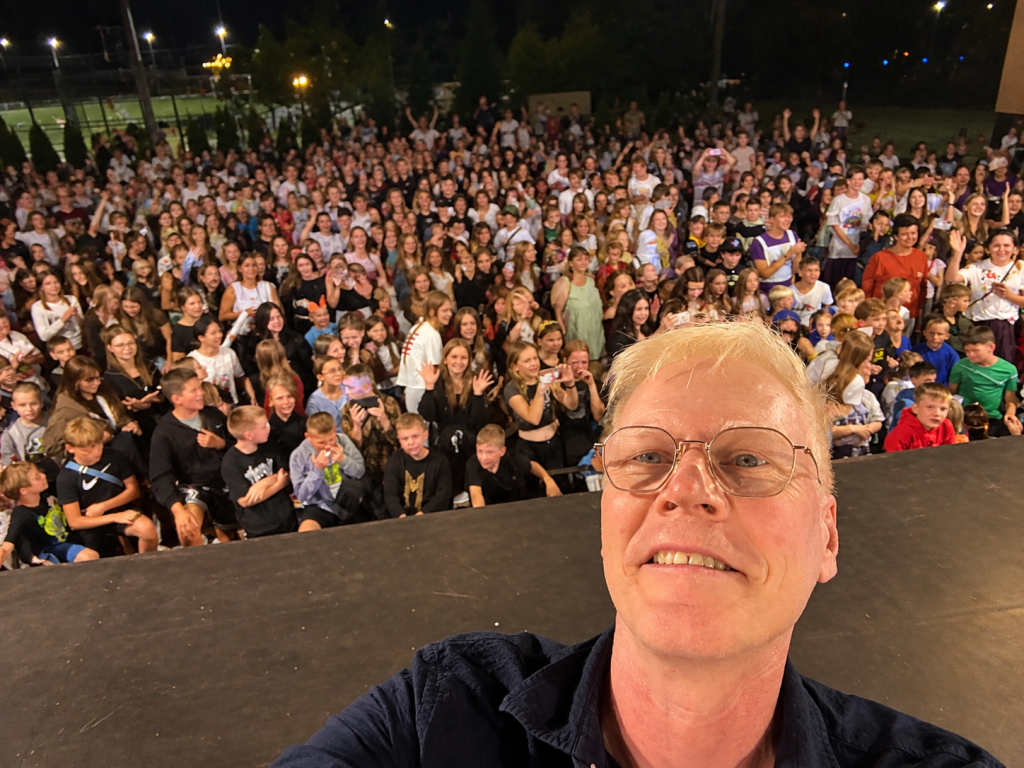
Michael Brady captures the view from the stage at Camp Dreamland 2026. After seven camps, returning children recognize familiar faces and relationships pick up where they left off—a reminder that camp may last two weeks, but the connections continue throughout the year.
Generosity can mean writing a check. Sometimes it means getting on a plane.
This summer, I returned to Ukraine with Frontier Horizon for Camp Dreamland, where 300 children came together for a chance to laugh, play, make friends and experience some of the things childhood should be about.
This was my seventh camp in just a few years. And after seven camps, something has changed.
The kids know us.
They know why we’re there. They know we’re there for them. Returning campers recognize familiar faces, friendships pick up where they left off and, before long, new kids become part of that circle too.
This year, I got a pretty memorable reminder of that before camp had even really begun.
Feeling Like a Rock Star—for a Very Good Reason
At the beginning of camp, I was introduced on stage in front of 300 kids.
Suddenly, they were yelling and chanting my name.
For a few minutes, I’ll admit, it makes you feel a little like a rock star.
But underneath the fun of a moment like that is something much more meaningful to me.
After seven camps, our reputation precedes us. The children know we’re coming back. They know the people from Frontier Horizon aren’t simply appearing for a few days, taking some pictures and disappearing again.
We’ve built relationships.
Some of the kids are young friends I’ve known from previous camps. Others I’m meeting for the first time. Some children naturally need a little more attention than others—and they’ll find us. Sometimes what they need at that moment is simply some extra time, some encouragement, some love or a hug.
Returning young friends or making new ones, it’s all good.
And that’s a big part of why I keep going back.
Camp Is Two Weeks. The Work Is Twelve Months.
One thing I want people to understand better about Camp Dreamland is that the work isn’t really about two weeks of camp.
It’s 12 months of work for the opportunity to spend about two weeks together.
Yes, camp gives children an opportunity to simply be kids—and that matters tremendously.
But being together also gives Frontier Horizon and our Ukrainian partners an opportunity to see how the children are really doing.
Is there a physical health concern that needs attention? Is a child struggling emotionally? Has something changed in their home or living situation? Does someone need additional support between camps?
Those needs aren’t always visible from a distance.
Relationships help us see them.
And once camp ends, our partners continue the work on the ground while Frontier Horizon looks for ways to help provide resources, connections and support from here.
That’s why I think it’s important to change the narrative around what these camps accomplish.
We’re not simply creating two good weeks for kids living through extraordinarily difficult circumstances.
We’re building relationships that help us better understand what they may need during the other 50 weeks of the year.
Sometimes showing up means joining the fun. Michael Brady races campers during an activity at Camp Dreamland 2026—one of the many moments that allows kids to simply be kids while strengthening relationships that continue long after camp ends.
Why Being There Matters
I believe generosity is most powerful when it brings us close enough to understand one another.
Supporting Frontier Horizon financially matters. Those dollars make the work possible, and we work hard to stretch them as far as we can so we can help as many children as possible.
But being there matters differently.
It allows me to see the work firsthand. It lets me know the people making it happen. Most importantly, it gives me the opportunity to know the children themselves—not simply as a number in a report or a photograph from thousands of miles away, but as individual kids with personalities, friendships, challenges, senses of humor and hopes for their futures.
Some of those relationships now extend well beyond camp.
I stay in touch with children I’ve gotten to know over the years. I think about them when I’m home. I advocate for them when they need something. And when I return to Ukraine, I get to see how they’ve grown and learn what’s changed since the last time we were together.
That’s very different from simply making a donation.
For me, it’s also what generosity has increasingly come to mean.
Generosity Is a Relationship
At Generosity Wealth Management, we talk a lot about living generously.
I don’t believe that has to mean traveling halfway around the world. It doesn’t have to mean supporting the causes I support or giving in the same ways I choose to give.
But I do think there’s something powerful about getting close enough to whatever you care about to understand it.
Maybe that’s through your financial resources. Maybe it’s your time or professional expertise. Maybe it’s serving on a board, mentoring someone, making an introduction or consistently showing up for an organization you believe in.
The form can be different for every person.
For me, Camp Dreamland has become one of those places where generosity has turned into relationship.
And once you know the kids, once they’ve yelled your name from a crowd of 300, run over looking for a hug or picked up a friendship exactly where you left it months earlier, it’s pretty hard not to keep coming back.
I returned home grateful, as I always do, for our Ukrainian partners who carry this work throughout the year, for the donors who make it possible and especially for the children who continue to trust us enough to let us be part of their lives.
Camp may last two weeks. The relationships—and the work—continue all year.